
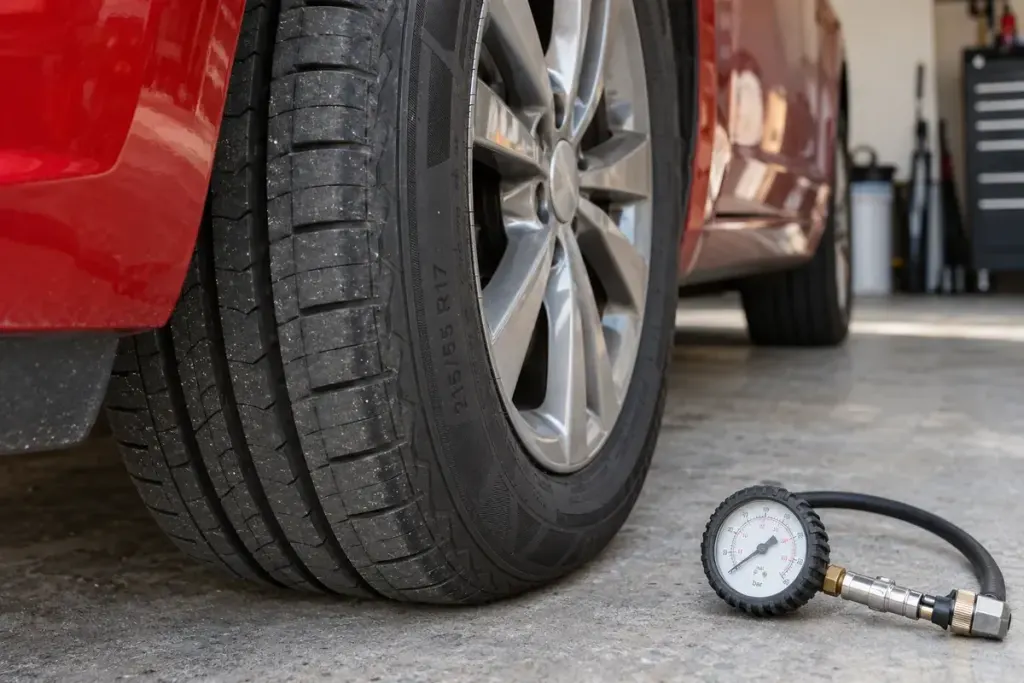
A tyre sidewall carries enough numbers to make a quick pressure check unexpectedly confusing. One figure looks like a pressure limit, another belongs to the size, and a code may identify manufacturing information. None should be copied into a pump simply because it is the easiest number to find.
Begin with the vehicle’s recommendation and the instructions for its fitted tyres. This article is a reading guide, not a substitute for the owner’s manual or a technician’s assessment of a damaged or incorrectly fitted tyre.
Find the vehicle placard first
Look for the tyre-information label in the location specified by the vehicle manufacturer, commonly around the driver’s door opening, and consult the owner’s manual. Recommendations can differ between front and rear axles or loading conditions.
NHTSA’s tyre-safety guidance explains that the vehicle manufacturer’s recommended cold pressure is found on the vehicle label or in the manual, rather than taken from the maximum pressure marked on a tyre. It also explains the importance of checking tyres cold. Follow the instructions applicable to your vehicle and equipment.
Copy the full instruction, including units
A note saying only “32” is incomplete. Record the unit and which axle or load condition it applies to. Tyre inflators may display different units, so confirm the setting before adding air. Do not guess a conversion or assume the same value applies to a spare tyre.
A practical record might contain four fields: vehicle label location, front recommendation, rear recommendation and the manual page. Fill these from the actual car. A photo of the placard can be useful if it is clear and stored where you can find it during the check.
Read the sidewall for a different set of questions
The sidewall helps identify the tyre fitted to the wheel. Size, load and speed markings need to be considered together when selecting a replacement, along with the vehicle manufacturer’s requirements. A similar-looking tyre is not necessarily an appropriate substitute.
If you notice that the fitted tyre differs from the documented specification, ask a qualified tyre professional to check compatibility. Avoid making a replacement decision from one matching number while ignoring the rest of the specification.
Notice condition as well as pressure
During a routine check, look for visible damage or an unusual change from previous readings. Pressure loss that returns repeatedly needs investigation; continually topping up does not explain its cause. A warning light is a prompt to follow the manual, not proof of the exact fault.
If a tyre looks damaged or the car behaves unusually, stop using it until the issue can be assessed safely. Do not attempt to repair sidewall damage based on a general online guide. The right action depends on the tyre and the fault.
Make the next check easier
Keep your pressure gauge and vehicle note together. Write the date and any unusual observation, especially if a tyre repeatedly differs from the others. That record can help a workshop understand the pattern without relying on memory.
A useful tyre routine separates information from interpretation: the placard tells you the vehicle recommendation, the sidewall identifies the tyre, and the condition check raises questions that may need professional attention. Knowing which source answers which question prevents a very ordinary number from becoming a misleading instruction.