
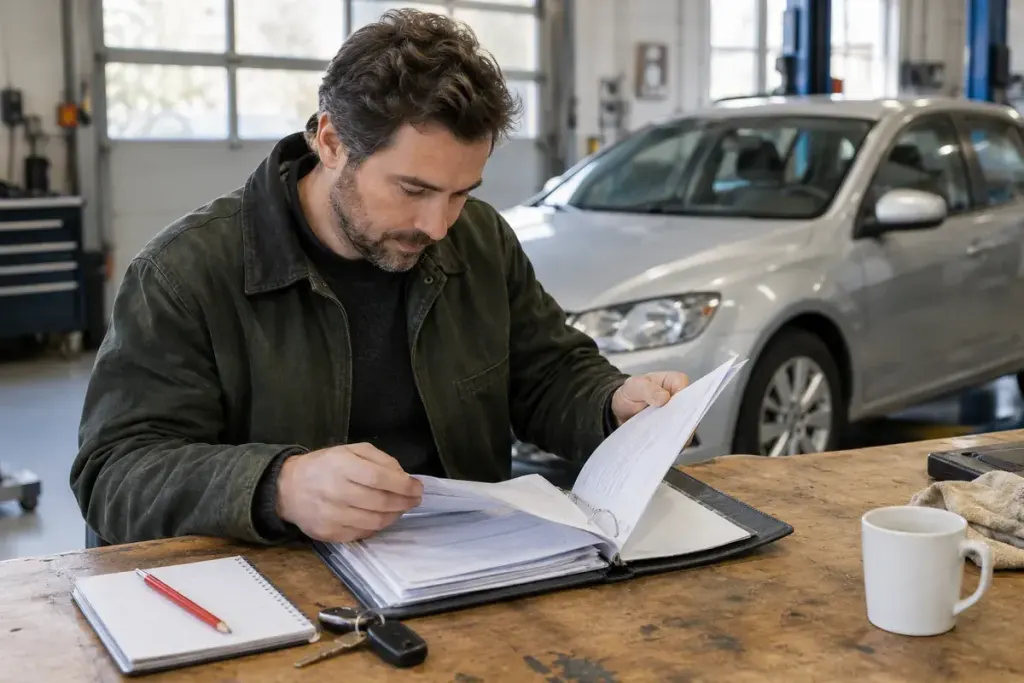
One used car has a low mileage figure and a thin folder. Another has travelled farther but comes with a clear maintenance record. The odometer is easy to compare; the ownership story takes more work.
Neither description settles the buying decision. A useful next step is to organise the available evidence so you can see what is documented, what is missing and what an independent inspection needs to investigate.
Put dates and mileage in one sequence
List the records chronologically, noting the date, mileage, work described and source. Distinguish a paid invoice from an estimate or a handwritten reminder. A stamp alone may not explain which work was completed.
Check that the documents refer to the vehicle you are considering, without publishing the seller’s private details. If something does not fit, ask for clarification. A gap is a reason for a question, not automatic proof of dishonesty or neglect.
Compare the record with the correct maintenance schedule
Find the manufacturer’s schedule for the model, engine and market. Some tasks depend on elapsed time as well as distance, and operating conditions can affect the relevant guidance. Do not assume low mileage means every scheduled item is far away.
In an illustrative comparison, two cars may show the same distance but have very different ages. The right question is what each manufacturer’s schedule required over that period, not which seller has the more impressive stack of paper.
Separate routine work from a solved problem
An invoice can show that a part was replaced without explaining whether a recurring symptom was resolved. Ask about repeat visits, warning lights or the reason a particular repair was undertaken. Record the answer as the seller’s account until other evidence supports it.
A useful inspection question might be: “There are several cooling-system invoices close together; can the inspector assess the system and explain any remaining concern?” That is more productive than diagnosing the car yourself from a part name.
Arrange an inspection with a clear scope
The US Federal Trade Commission’s used-car guidance recommends an independent mechanical inspection and explains why a history report does not replace it. Its dealer paperwork and warranty rules are US-specific; use the consumer requirements that apply where you buy.
Ask the inspector what is included, what cannot be assessed and whether the resulting report identifies likely follow-up work. A short visual check and a detailed mechanical assessment are different services. Confirm the scope before assuming that a clean report means every component was tested.
Turn uncertainty into a buying decision
Group your notes into confirmed work, unresolved questions and likely near-term costs that need a quotation. Avoid inventing repair prices or subtracting a guessed total from the asking price. Obtain appropriate estimates if an issue matters to your budget.
If key information remains unavailable, decide whether you are comfortable proceeding under that uncertainty. Walking away can be a reasonable outcome; no folder or mileage figure obliges you to buy. The best record is the one that helps you ask sharper questions about the actual car, rather than making an attractive number do all the thinking.