
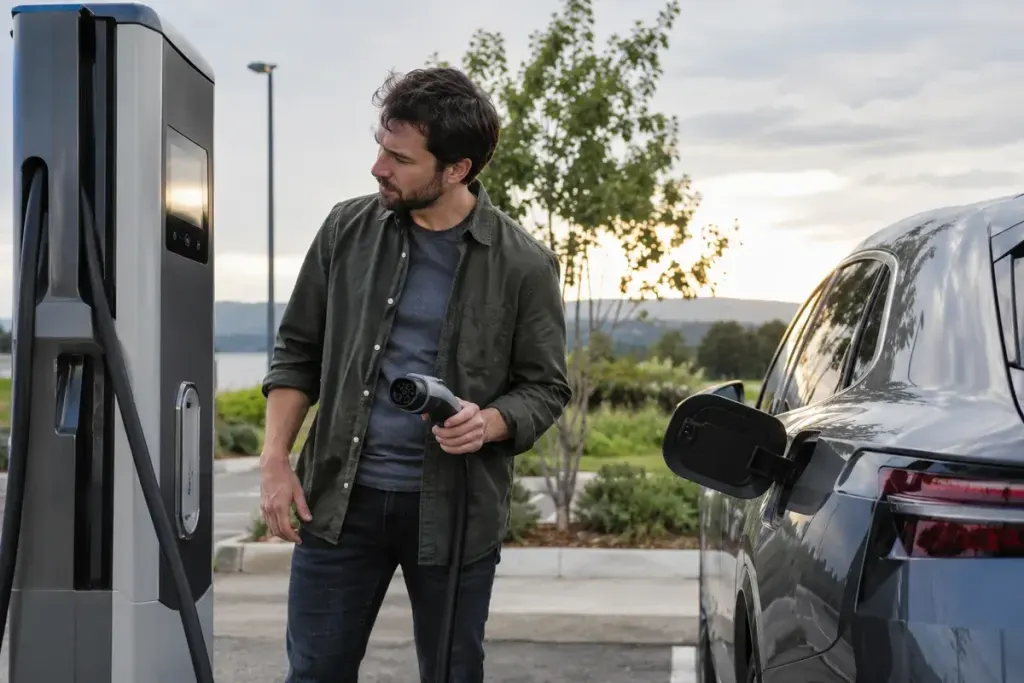
The connector in the station photograph looks right. That is encouraging, but it is not the whole charging plan. A usable stop also depends on the vehicle’s supported charging system, the site’s availability and the way the session is started.
These checks are particularly useful with a hired EV or when crossing borders, where a familiar brand name may sit beside different equipment and payment arrangements.
Identify the vehicle before the station
Use the exact model’s manual or manufacturer information to establish its AC and DC charging capabilities and supported connectors. Do not infer them from another model in the same range. The US Department of Energy’s charging-station overview explains why charging levels and connectors are distinct considerations; regional standards and individual vehicles still need their own check.
A station’s headline power is not a promise that your car will receive that power continuously. The vehicle, equipment and conditions influence the session. Build journey time around a sensible allowance rather than one best-case advertising figure.
Check how you will actually use the site
Look at opening hours, access restrictions, parking rules and the operator’s current payment instructions. A charger inside a hotel car park may have different access from one at a public motorway stop. An app account that is needed at the barrier is less convenient to create when mobile reception is poor.
Save the operator’s official support details and a second compatible location. A map pin is not a reservation, and a recent status indicator can change before you arrive.
Treat adapters as specific equipment
Use only adapters explicitly approved for the vehicle and charging arrangement by the relevant manufacturers. Mechanical fit is not sufficient evidence of electrical compatibility. Do not improvise with damaged connectors, household extension arrangements or an adapter whose provenance you cannot establish.
For a rental, ask the provider which cables and adapters are supplied and permitted. Photograph the supplied equipment for your own record, then check it against the handover information rather than guessing at an unfamiliar cable.
Write a five-line charging note
For an unfamiliar trip, record the vehicle connector, charging type, operator, access/payment method and fallback site. Add the date checked. This small note is easier to use at a service area than a folder of unlabelled screenshots.
If the session will not start, follow the vehicle and station instructions and contact the operator. Repeatedly forcing the connector or trying unsupported combinations adds a new problem. A good plan leaves enough battery margin to use the fallback safely instead of relying on one uncertain stop.