
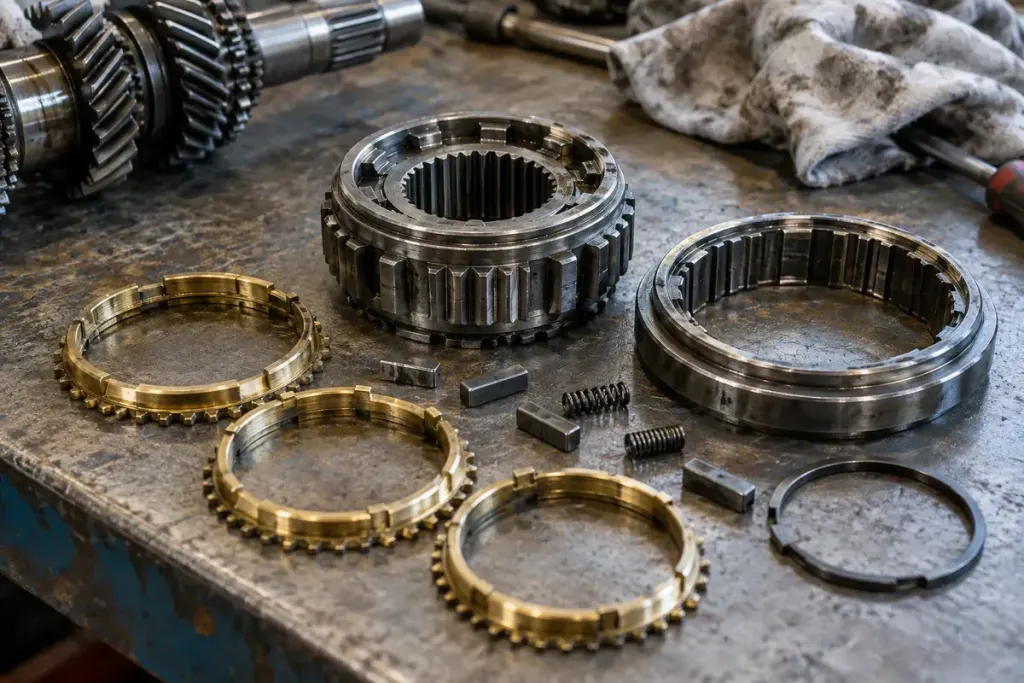
A manual gear lever feels like a direct command, but moving it starts a mechanical process inside the transmission. In a synchronised gearbox, the selected parts need compatible rotational speeds before engagement can be completed smoothly.
Eaton’s guide to synchronised manual transmissions explains that synchronisers equalise the speeds of rotating gears and shafts. Its driving guidance concerns the transmissions it describes; the correct procedure for your vehicle remains the one in its own documentation.
Disengaging the clutch separates the engine’s drive from the transmission input as designed. The synchroniser deals with the speed matching needed within the gearbox for the selected ratio. Treating these as one component makes a shifting complaint harder to describe.
Not every transmission or every gear uses the same arrangement. Do not assume an older vehicle, a heavy commercial gearbox and a modern passenger car can all be driven with an identical technique.
Report the pattern rather than naming the failed part
If a shift becomes difficult, note which gear, whether the vehicle is cold or warm, and whether the problem occurs consistently. Describe resistance, noise or incomplete engagement separately. “Second gear resists when cold” gives a technician more information than “the synchro is gone.”
A problem may involve more than the synchroniser. Clutch operation, linkage, lubricant specification and other mechanical conditions can matter. Diagnosis needs the vehicle and appropriate tests, not a comparison with a video of another car.
Do not force the lever through resistance or repeatedly recreate a noisy shift to prove it exists. Arrange a qualified inspection and follow the vehicle’s guidance on whether it should be driven. A short written account can preserve the observation without another damaging attempt.
Understanding the synchroniser is useful because it explains why a smooth shift involves timing and compatible speeds. It does not make every awkward gear change a single-part repair. Keep the mechanism, the symptom and the eventual diagnosis as three distinct pieces of information.