
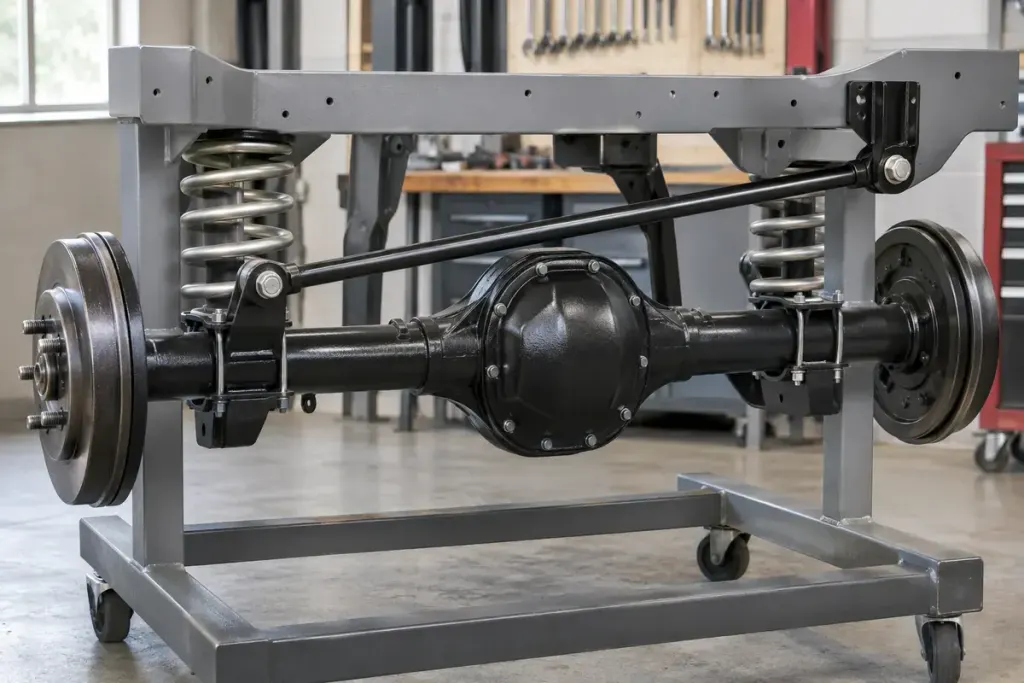
A solid axle needs to stay located sideways beneath the vehicle as well as move up and down. A Panhard rod performs that lateral locating job by linking the axle to the body or chassis. Because its ends pivot, the connection follows an arc rather than a perfectly vertical line.
Whiteline’s explanation of Panhard rods describes how a change in ride height can alter the rod’s angle and the axle’s lateral position. This is why a suspension change can affect more than the distance between the tyre and wheel arch.
Separate the locating link from the spring
The rod is not there to replace the spring or damper. Its task is to constrain sideways movement. Worn mounting bushes, an unsuitable replacement or an incorrect adjustment can therefore produce concerns that cannot be understood simply by discussing spring stiffness.
Imagine a link with one end fixed to the chassis. As the other end rises, it travels around that pivot. The amount of sideways movement depends on the geometry, including the link’s length and angle. It is not a universal number that can be read from the vehicle’s advertised lift height.
Ask for a measured assessment
If the vehicle has been modified, ask a competent suspension specialist to check axle position at the specified ride height, clearances through movement and the condition of the mounting points. A photograph taken on sloping ground is weak evidence that the axle is centred correctly.
An adjustable rod is a means of setting length within a particular design, not a guarantee that every other consequence of a suspension change has been addressed. Steering, hoses and other links may also need assessment according to the vehicle and modification.
For an owner, the useful distinction is straightforward: a Panhard rod locates sideways, and its geometry changes as it pivots. Knowing that makes it easier to ask what was measured and corrected, rather than accepting “it fits” as the complete explanation.