
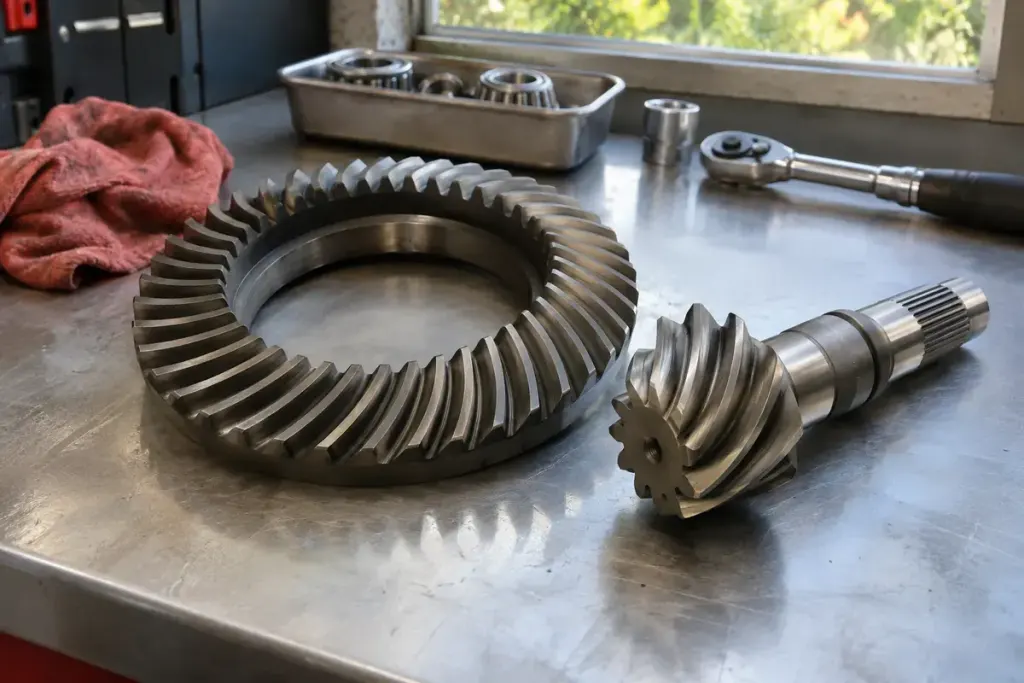
A rear axle housing contains more than a simple right-angle turn. In many final drives, the pinion shaft sits offset from the centreline of the larger gear. Hypoid gearing makes that arrangement possible.
Unlike a conventional intersecting-axis bevel arrangement, a hypoid pair operates with offset axes. The tooth geometry accommodates that layout and includes sliding contact. The KHK gear catalogue includes hypoid gearing and illustrates why shaft alignment matters to the contact pattern.
In a vehicle, the arrangement can help package the driveline at a useful height while transmitting torque through the final drive. It does not mean every differential or every right-angle gearbox uses hypoid gears. The differential mechanism and the final-drive gear pair also have different jobs, even when they share a housing.
What an owner can do with this distinction
First, identify the actual axle or gearbox fitted to the vehicle. A model may have several drivetrain options. Use the manufacturer’s specification for that assembly rather than choosing oil solely because a bottle mentions “gear lubricant”.
Second, separate a description from a diagnosis. A workshop’s mention of hypoid gears explains construction; it does not establish the cause of a whine, leak or vibration. Inspection, operating conditions and the vehicle’s service information are needed to investigate those symptoms.
For a practical record, note the vehicle identification, axle type if documented, specified lubricant and service invoice. That makes a future discussion about maintenance much clearer than remembering only the oil’s viscosity number.
Do not adjust gear contact or bearing settings by trial and error. Those are precision workshop tasks. The useful takeaway for an owner is understanding why the shaft layout, matched gear pair and correct lubricant belong together, rather than treating the axle as a generic box of interchangeable parts.