
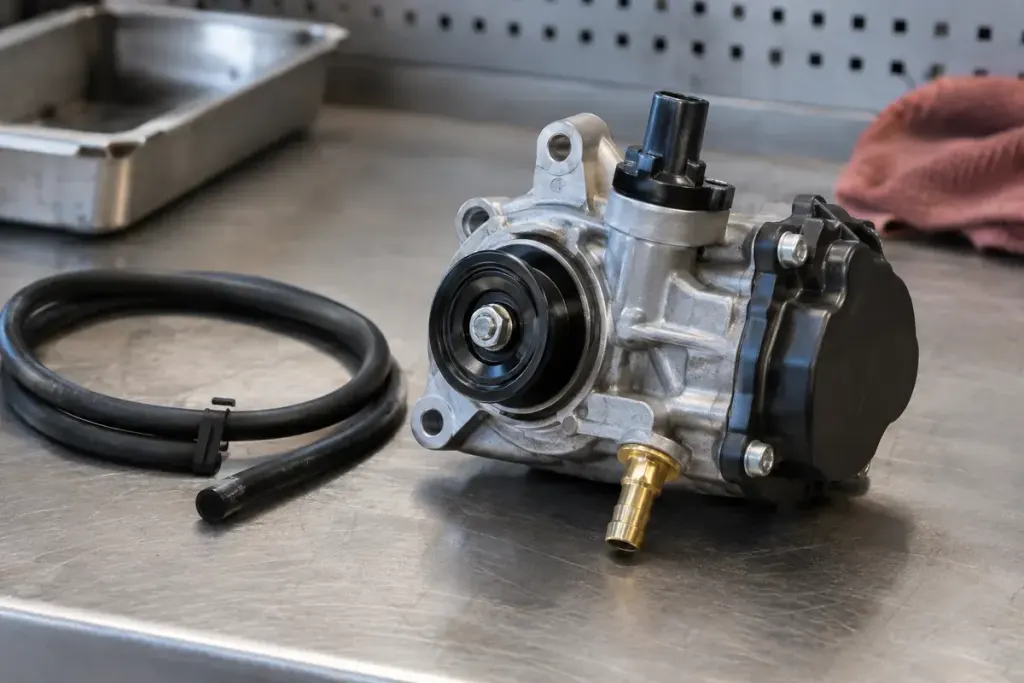
A vacuum-assisted brake booster reduces the effort a driver needs at the pedal. But the vacuum supply does not appear automatically in the same way on every engine. Some vehicles use a pump to provide or supplement it.
HELLA’s technical explanation describes electric vacuum pumps in several powertrain arrangements, including diesel, hybrid and some petrol applications. The relevant question is whether the vehicle’s pneumatic booster receives sufficient vacuum under its operating conditions. Not every car uses the same kind of brake assistance.
Assistance is one part of braking
The vacuum pump is not the hydraulic pump that directly pushes brake fluid to every wheel in an ordinary description of this system. It supports the pressure difference used by the booster. Mixing those functions can make a repair quotation difficult to understand.
A useful analogy is assistance at a heavy door: the helping force changes the effort needed, but it does not replace every hinge, latch and structural part. The analogy stops there—braking is a safety-critical system with vehicle-specific controls and failure behaviour.
If pedal feel changes, a warning appears or braking performance is doubtful, stop using the vehicle when safe and arrange professional assistance. Do not assume that a harder pedal is harmless because the wheels still seem to slow, and do not disconnect hoses or bypass controls to “test” the pump.
Give the workshop observations it can use
Record when you first noticed the change, whether the engine was running, any warning message and whether work had recently been done. A description such as “the pedal felt different after restarting” helps more than announcing a pump failure from a video.
Ask the workshop to explain what was tested and which part of the system the result concerns. Vacuum supply, hoses, check valves, sensors and the booster can be separate diagnostic considerations. A pump that runs is not, by that fact alone, proof that every part is functioning correctly.
Understanding the pump’s role helps you follow the diagnosis. It should make the conversation with a qualified technician clearer, not turn a driveway experiment into a substitute for checking the brakes properly.