
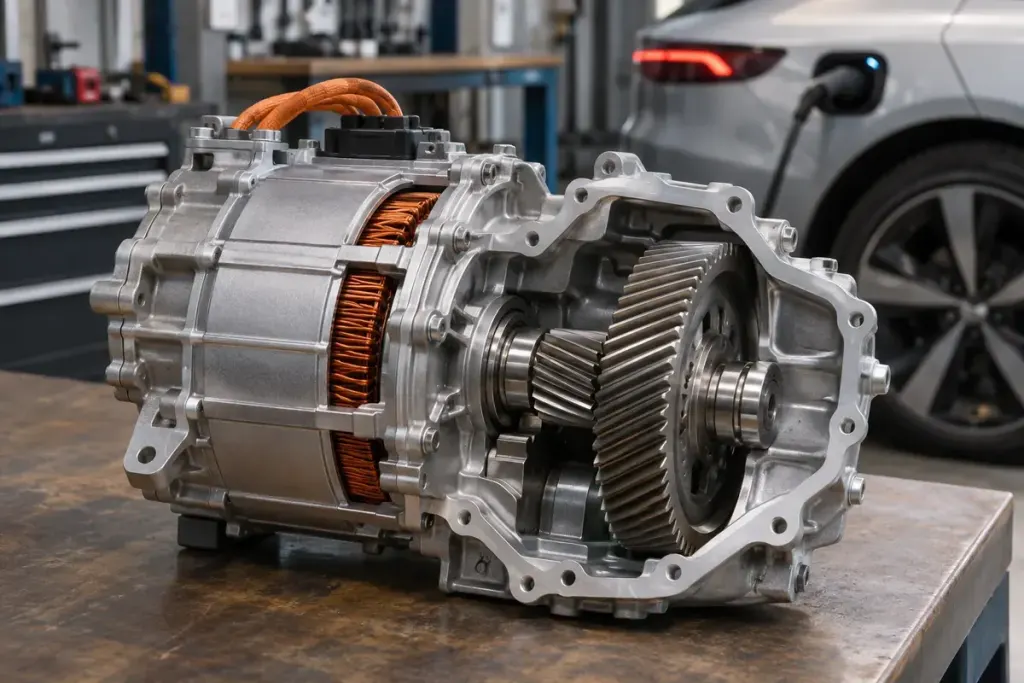
An electric car can accelerate without the familiar sequence of upshifts and still use gears between its motor and wheels. “Single-speed” describes the available ratio arrangement; it does not mean the motor is necessarily connected to the tyres without a transmission.
Bosch’s eAxle overview describes electric drive systems that combine a motor, power electronics and transmission components. That packaging makes the gearbox less obvious to the driver, but it does not remove its mechanical role.
What reduction gearing changes
A reduction gear arrangement trades rotational speed for torque at the output, allowing a fast-turning motor to drive more slowly turning wheels. In an idealised example, a 9:1 reduction means the input turns nine times for one output revolution. Real systems also have losses, and that illustrative ratio is not a specification for a particular car.
Electric motors can work across a broad speed range, which helps explain why many electric drives can use a fixed reduction rather than a conventional sequence of driving gears. Designs differ, however; some vehicles use more than one forward ratio.
Read the specification in context
When a brochure says “single-speed automatic,” look for the accompanying drivetrain description. Do not assume it uses a familiar torque-converter automatic or a belt-type continuously variable transmission merely because the selector has similar letters.
For ownership decisions, consult the exact vehicle’s maintenance schedule. A lack of felt gear changes does not establish that every component is maintenance-free, and another model’s fluid instructions are not a substitute for the correct handbook.
A useful question for a seller or workshop is: “Which drive unit and reduction gear arrangement does this version use, and what service requirements apply?” That connects the terminology to the actual car. The smoothness you feel from the driver’s seat is an operating characteristic, not an inventory of the parts beneath it.