
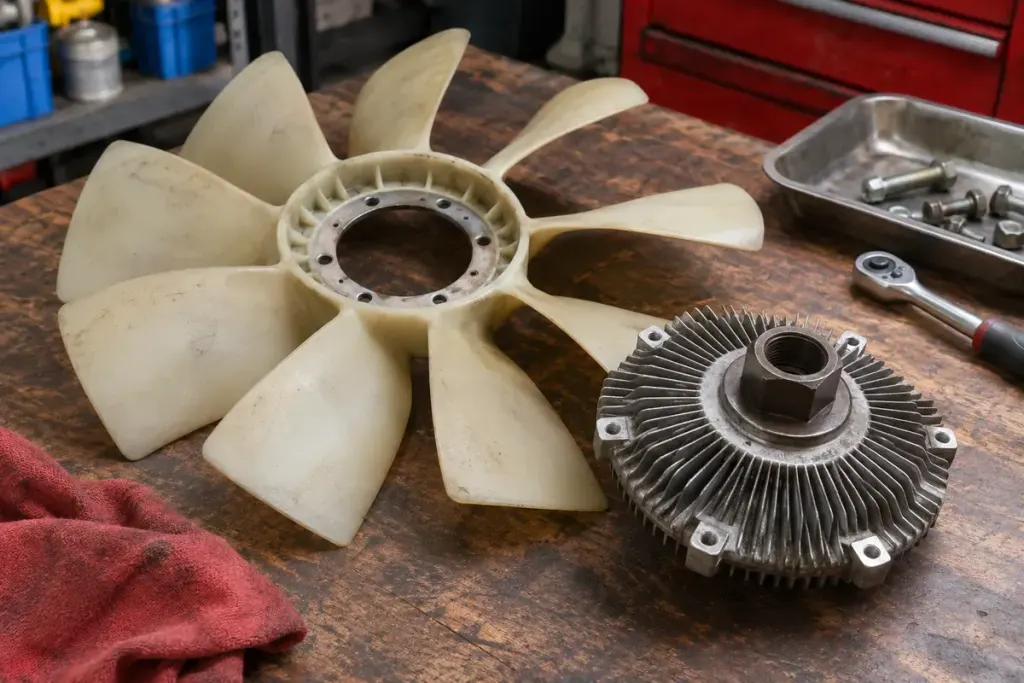
A belt-driven cooling fan does not necessarily remain rigidly locked to engine speed. A viscous coupling can vary how strongly the drive turns the fan, allowing the cooling system to respond to its operating conditions.
HELLA’s technical brochure describes a working chamber containing oil and a valve arrangement that changes the transferable torque. In thermal versions, temperature influences engagement; other designs can use electronic control. The exact system must be identified before interpreting its behaviour.
The coupling and the fan are different components
The fan moves air. The coupling determines how drive is transferred to it. A fault in one part should not be assumed merely because the other is visible or making noise.
For an owner, a useful workshop question is whether the vehicle uses a thermal viscous coupling, an electronically controlled coupling or an electric fan arrangement. Advice about one type may not apply to another.
Describe the operating conditions
If you notice a change, record whether the engine was cold, fully warm, idling in traffic or travelling at speed. Note any temperature warning and whether the sound changes after a short period. These details are more helpful than “the fan is always loud.”
Do not reach into the fan area or try to stop a moving fan as a test. Automatic operation, hot surfaces and rotating components make improvised checks dangerous. Follow the vehicle’s warning instructions and let a qualified workshop use the appropriate diagnostic procedure.
A replacement conversation should include the correct application and any related inspection needed. Matching a part only by its outside diameter overlooks the control and mounting requirements.
Understanding a viscous coupling is a way to recognise that fan speed can be controlled through a mechanical-fluid connection, and to ask questions that fit the actual design. It does not diagnose every cooling noise.