
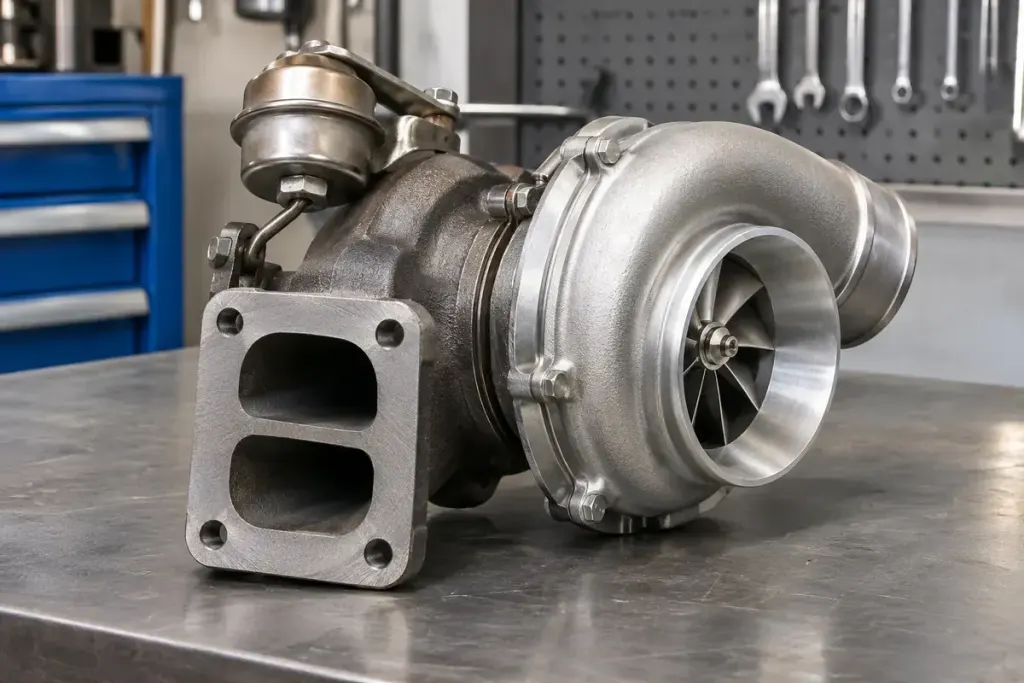
Twin-scroll describes passages within a turbocharger’s turbine housing. It does not, by itself, mean that the engine has two turbochargers. That distinction helps make sense of a specification sheet before performance claims enter the conversation.
In Garrett’s explanation of turbine housings, a divided housing provides separate exhaust paths. With an appropriately matched exhaust manifold, this arrangement can reduce interference between exhaust pulses and improve response. The benefit depends on the complete engine and turbo system; the label alone does not establish a particular power output or acceleration time.
Follow the exhaust side
An engine releases exhaust in pulses as cylinders pass through their cycles. The manifold routes those pulses towards the turbine. Keeping selected paths separate is useful only if the upstream arrangement supports that separation. Looking at the housing without considering the manifold leaves out part of the design.
For a simple drawing, sketch the cylinders on one side and the turbine on the other. Draw two separate routes between them, then mark the point at which the turbine extracts energy. This illustrates the idea without assuming that every engine uses the same cylinder pairing. Firing order and engine layout matter.
Questions worth asking about a used car
If a seller highlights a twin-scroll turbo, ask for the exact engine specification and service history. Distinguish an original factory installation from an altered exhaust or turbo system. A description in an advertisement is not evidence that modifications have been designed, calibrated or approved correctly.
On a test drive, assess the vehicle’s behaviour as a whole rather than trying to prove the housing design from the sensation of acceleration. Gear selection, engine speed, throttle control and transmission strategy all affect that experience. Understanding twin-scroll gives you a better question to ask about the hardware; it does not replace an inspection of the car you may buy.