
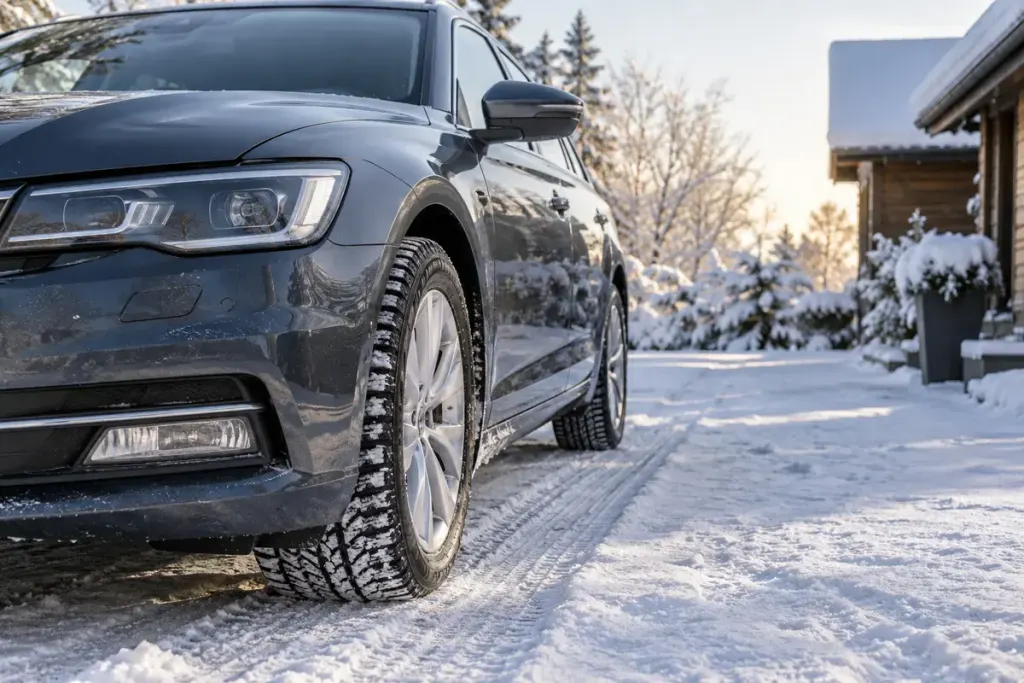
An all-wheel-drive car pulls away from a snowy junction with little drama. That easy start can create confidence the road has not earned. Getting moving and stopping are different demands on the tyres and surface.
Driving more wheels can help the vehicle apply propulsion where grip is available. It does not remove the limits of tyre contact with snow or ice. A manufacturer’s Ford manual hosted by NHTSA makes this distinction explicitly: improved acceleration in snow does not mean a shorter stop simply because the vehicle has four-wheel drive.
Judge the road beyond the first junction
Conditions can change between a treated main road, a shaded bend and a bridge. A successful acceleration a minute ago is not a reliable test of the surface ahead. Slow down appropriately and increase space so you have more time to respond.
Follow local winter-driving advice and the vehicle manual. Check the specified tyre condition, pressure and suitability for the conditions. A drive-mode button cannot compensate for unsuitable or worn tyres.
Do not use a public road as a test area
Avoid sudden braking experiments to see how slippery it is. They can endanger other road users and may tell you little about the next stretch. If travel is unsafe or authorities advise against it, postpone the journey.
In an invented planning example, a driver has enough traction to leave a driveway but must descend a steep untreated lane. The ability to leave is not the same as the ability to complete that route safely. The decision should include the descent and the return journey.
Know what your particular system does
All-wheel-drive and four-wheel-drive systems differ. Some settings have restrictions on where or how they may be used. Read the manual rather than treating every system as interchangeable, and obtain qualified instruction for unfamiliar conditions.
Winter confidence should come from suitable equipment, conservative planning and conditions you can manage. The badge on the tailgate describes part of the drivetrain; it does not describe the stopping distance available on the next icy bend.