
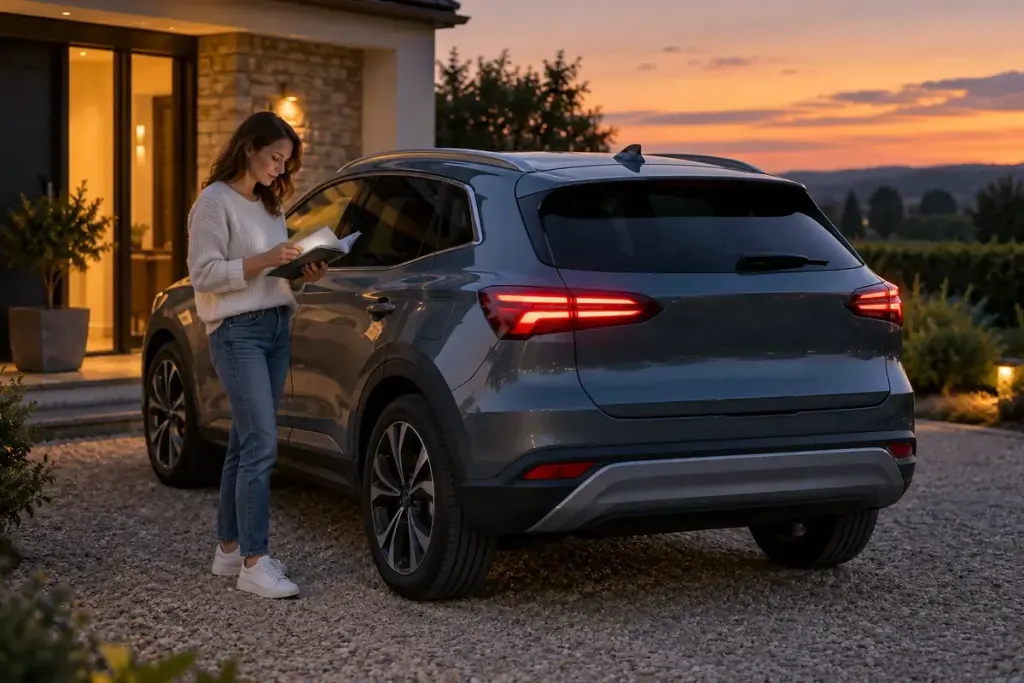
A car can show bright lights at the front while its rear lighting remains different from what the driver expects. Daytime running lights are intended to help a vehicle be seen during the day; they are not a universal indication that all the lights needed for darkness or poor visibility are active.
Transport Canada’s vehicle-lighting guidance warns that an illuminated dashboard does not necessarily mean the appropriate exterior lights are on. It also explains differing lighting arrangements and newer Canadian requirements. The exact behaviour depends on the vehicle, market and configuration, so use your own handbook rather than generalising from another car.
Check from outside while safely parked
Identify the handbook’s daytime-running-light, headlight and automatic-light sections. With the vehicle safely stationary, follow the specified procedure and have an adult help observe which lamps illuminate. Keep the vehicle secured and avoid experimenting with controls while driving.
Compare the actual front and rear lights with the dashboard indicators described in the manual. A glowing instrument panel is not the same evidence as checking the lamps themselves. Nor does an automatic setting remove the driver’s responsibility to use appropriate lighting for the conditions and local rules.
Consider circumstances that are dim or low-contrast without looking like full night, such as rain or mist. Learn how to select the appropriate lights manually if the handbook requires it. Do not assume a brightness sensor recognises every situation in which other road users need to see you clearly.
If expected lamps do not work or the controls behave inconsistently, arrange a proper inspection. Avoid altering wiring or defeating the vehicle’s lighting logic as a casual workaround.
For a borrowed or newly acquired car, make this check before the first unfamiliar journey. The useful outcome is a clear answer to a practical question: which lights are actually on, and which control provides the lighting the present conditions require?