
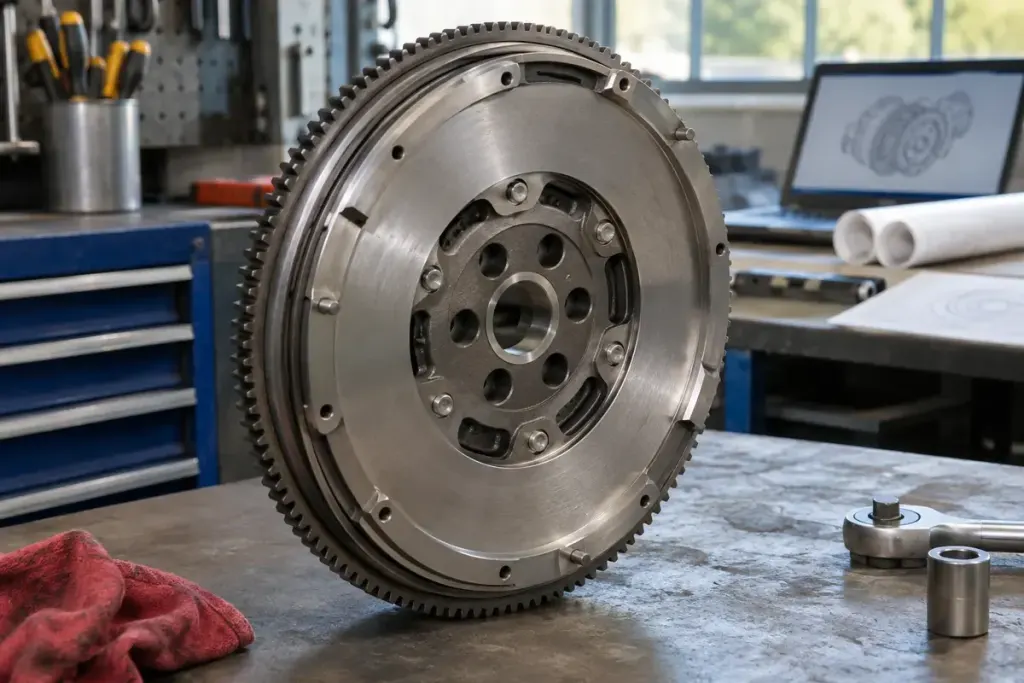
An engine does not deliver perfectly smooth torque through every moment of its cycle. A dual-mass flywheel helps manage the resulting twisting vibration before it passes farther through the drivetrain.
As explained in Schaeffler’s technical guide, the design separates primary and secondary masses and connects them through a spring-and-damping arrangement. The relative movement is part of its function, not simply unwanted looseness.
“Dual mass” does not mean “dual clutch”
The terms describe different components and jobs. A dual-mass flywheel concerns the management of torsional vibration. A dual-clutch transmission describes a transmission arrangement. Seeing one term in a specification does not let you infer every detail of the other.
For an owner, the most useful question is which components are fitted to the exact engine and transmission combination. A model name alone can cover several drivetrains.
A noise is the start of diagnosis
ZF’s service information warns that noises attributed to a dual-mass flywheel can originate in surrounding systems. Replacing the named component without checking the cause can therefore leave the underlying problem unresolved.
Before a workshop visit, describe the circumstances: starting, idling, pulling away or switching off. Note whether the behaviour is new and whether other warning signs appear. A short recording made safely while the car is stationary can help communicate a symptom, but it is not a remote diagnosis.
Ask the workshop what tests support its conclusion and what related checks are included in the proposed work. If a quotation recommends a conversion or a different design, ask how compatibility and the vehicle manufacturer’s requirements have been assessed.
Do not use a generic online allowance for movement or noise to approve your own unit. Designs and test procedures vary. Understanding the flywheel’s purpose should make the repair conversation clearer, not turn an unfamiliar rattle into a certain diagnosis.