
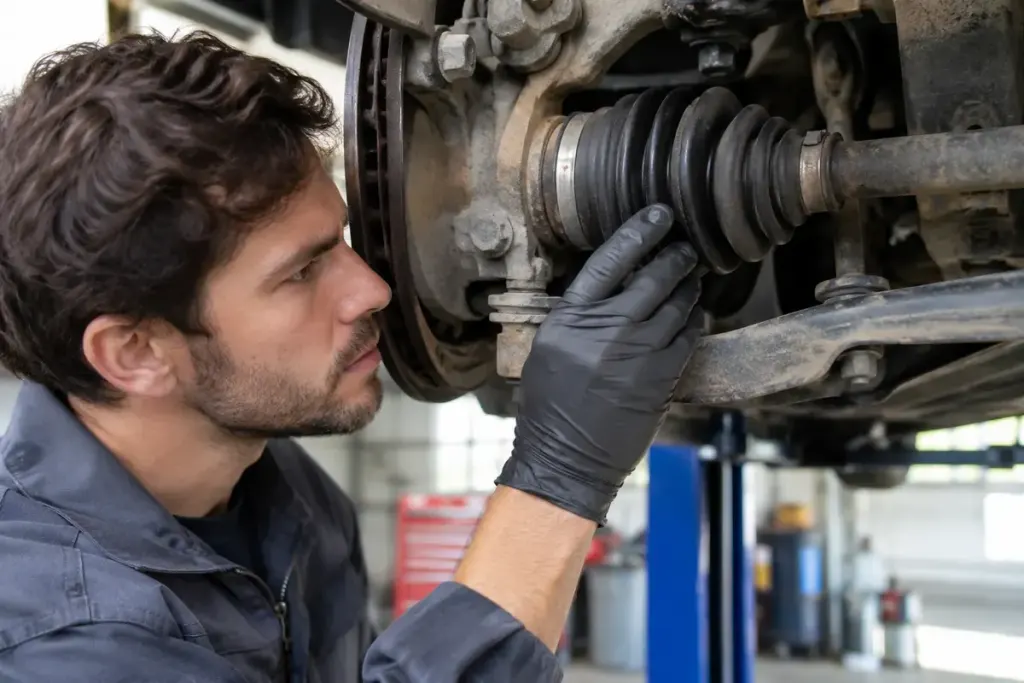
A service report mentions a split CV boot, yet the car still feels normal. That does not make the finding trivial. The flexible boot protects a constant-velocity joint while allowing movement; a tear can compromise that protection before the driver notices a clear symptom.
GKN Automotive’s driveshaft inspection guidance includes checking boots and clamps, grease contamination and joint condition. The important distinction is between spotting a damaged cover and determining whether the joint beneath it is still serviceable.
Ask what the inspection actually found
Request the location of the affected boot and, where available, a workshop photograph. Is it cracked, torn or displaced at a clamp? Has grease spread onto surrounding components? Has the joint developed abnormal play or noise? These details explain why a repair recommendation may go beyond replacing the rubber part.
A fresh tear and a joint that has run contaminated for an unknown period are not necessarily the same repair. Equally, a boot finding alone does not prove that every component on the driveshaft must be replaced. The workshop should explain its assessment.
Make the next step specific
Ask whether the car is safe to drive in its current condition and how urgently the work is needed. If there is a new noise, vibration or change in driving behaviour, describe when it occurs rather than diagnosing the cause yourself. Similar symptoms can have other sources.
Keep the quotation clear about parts, labour and what happens if further joint damage is discovered during the repair. This makes two estimates easier to compare than a vague line labelled “axle work.”
Do not crawl under a vehicle supported only by a jack to investigate. A proper inspection needs safe access. The useful owner action is to understand and act on the finding before a small protective component becomes a more expensive uncertainty.