
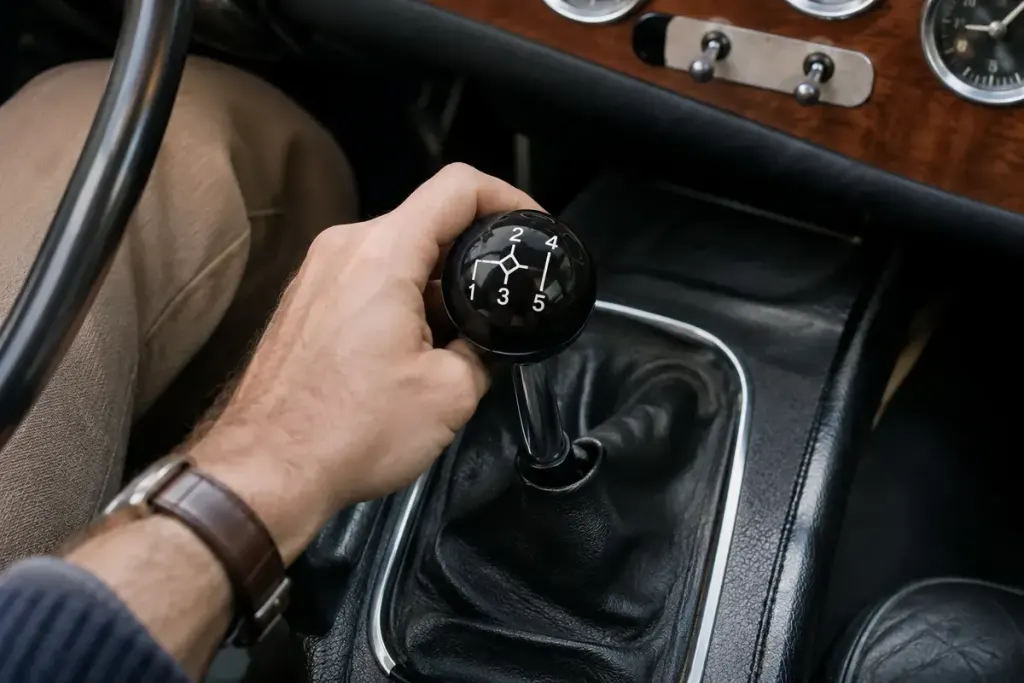
You sit in an unfamiliar manual car and instinctively reach towards the upper left for first gear. On a dogleg layout, that habit may be wrong. The gear pattern needs to be read before the car moves, even if you have driven manuals for years.
BMW’s description of the M3 E30 Convertible places first gear at the lower left of its pattern. The arrangement groups the higher forward gears in a way associated with the model’s sporting purpose. It is a specific example, not a statement that every old BMW has the same gearbox.
Read the pattern as a map
Identify first, second and reverse from the actual vehicle’s documentation and controls. Do not assume that a replacement gear knob accurately represents the installed transmission. Classic cars may have undergone changes that are not obvious from the cabin.
Ask the owner or a qualified instructor to explain the reverse lockout and any unusual shift action. Keep the vehicle safely secured and follow its operating instructions while familiarising yourself. A public-road junction is the wrong place to discover that a familiar hand movement selects a different gear.
Separate the layout from the condition
An unfamiliar pattern can explain initial hesitation, but it does not explain every difficulty engaging a gear. Do not force the lever through resistance or dismiss a persistent problem as simply a characteristic of a dogleg gearbox.
For a viewing or inspection note, record the claimed transmission, the observed pattern and any documented conversion. Ask a suitable specialist to assess concerns rather than trying to diagnose clutch or gearbox condition from one awkward shift.
The same discipline helps when reading a car review. “Dogleg” describes the arrangement of the shift pattern; it is not an automatic guarantee of better driving, stronger components or a particular ratio set.
Once the map is familiar, the layout becomes another learned control. The essential first step remains modest: verify where the gears actually are before letting muscle memory decide.