
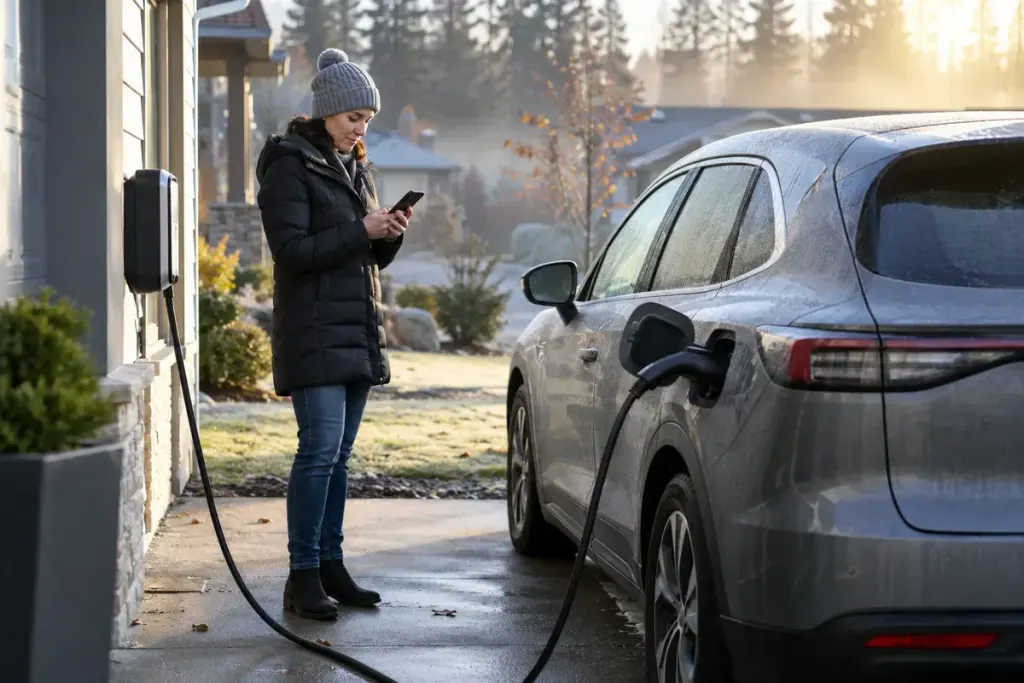
A warm cabin is welcome on a cold morning, but an electric car’s preconditioning feature can involve more than cabin comfort. Depending on the model and settings, it may also prepare the battery for use. The word on the app does not tell you exactly which system is operating.
The US Department of Energy’s cold-weather EV review discusses preconditioning while connected to the grid as a way to preserve battery energy for the trip. The benefit and behaviour depend on the vehicle, conditions and available charging power.
Read the departure setting literally
Check whether the time means “begin warming now” or “be ready to leave at this time.” Confirm which days repeat, whether the car must be plugged in and what happens if the battery is below a required level.
Cabin preconditioning before a journey and battery preparation for rapid charging may be separate features. A comfortable interior does not prove that the battery has reached a temperature suitable for the fastest possible charging.
Try the routine before an important journey
On an ordinary morning, observe whether the schedule activates, whether the cable remains connected and how the app reports the process. Do not infer exact energy use from a single range estimate, which can change with temperature and other conditions.
Check the charging schedule as well. A departure plan can interact with off-peak settings, charge limits and the available supply. Use the manual or manufacturer support to understand the combination rather than changing several options at once.
Keep the usual visibility checks: clear the windows, mirrors and lights, and remove snow or ice safely. Preconditioning does not guarantee every surface is clear.
If your routine changes for a holiday or a different shift, review the repeating schedule. A useful setting should prepare the car when you actually leave, not continue running because last month’s weekday timetable is still saved.