
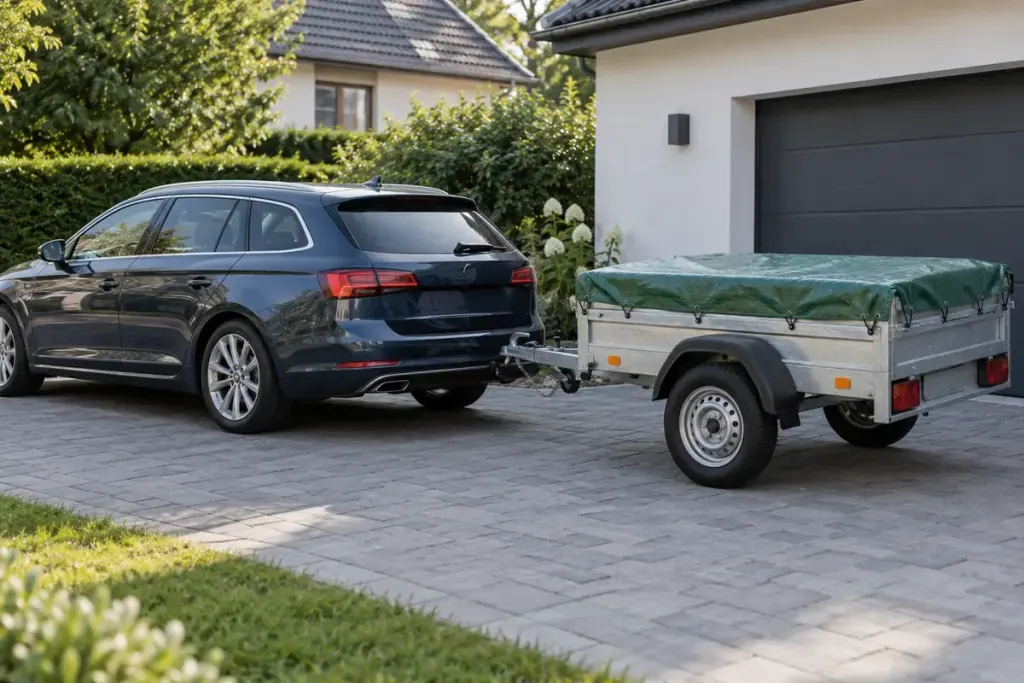
A car has a towbar and the trailer connects neatly. That does not establish how much the combination may carry. Before planning the trip, collect the limits for the specific vehicle and trailer rather than relying on the towbar’s appearance.
Read the separate limits together
Use the vehicle handbook, manufacturer’s plate and approved towing information for the exact model. Check the trailer’s ratings and the coupling requirements as well. The permitted trailer weight and the permitted total combination weight answer different questions.
For a UK example, GOV.UK’s towing guidance explains the role of the vehicle’s towing and train-weight limits. This is jurisdiction-specific guidance; licensing, dimensions and operating rules must be checked for the country where you will drive.
Include what will actually travel
The trailer’s empty weight is not its loaded weight. Include luggage, equipment and other items, while also accounting for passengers and load in the car. Do not assume that a vehicle’s maximum towing figure can always be combined with every other maximum at the same time.
Ask a competent towing specialist to explain any unclear limit, including coupling load and compatibility. Where actual weights are uncertain, use an appropriate weighing service rather than estimating from how low the suspension looks.
Loading distribution, secure attachment, lights, tyres, brakes where fitted and visibility all need the relevant checks. Follow the manufacturer’s instructions and local requirements. A correct weight calculation does not replace those safety tasks.
Keep a small record of the vehicle and trailer identification, applicable limits and the loaded arrangement you checked. Revisit it when the trailer, passengers or cargo changes. If you are inexperienced, obtain suitable training before a demanding journey.
The useful question is not simply whether the car can pull the trailer. It is whether the complete, loaded combination is compatible, permitted and prepared for the route you intend to use.