
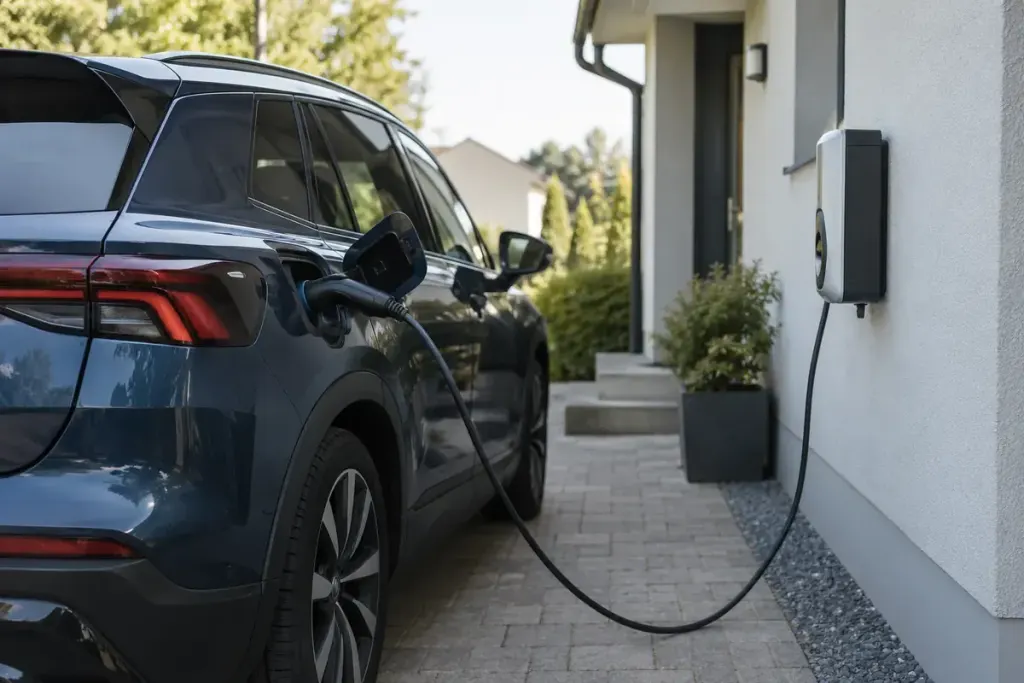
A wallbox advertised with a high power rating can look like an instant shortcut to faster charging. But the car has a say in the result. During AC charging, the vehicle’s onboard charger converts incoming alternating current into the direct current used by the battery, and its capacity is one of the limits in the system.
The US Department of Energy’s Alternative Fuels Data Center lists vehicle charger capacity, battery condition, charging equipment, and electrical supply among the factors affecting charging time. The number on the wallbox is therefore only part of the specification.
Compare compatible ratings
Read the AC charging specification for the exact model and version of the car. Do not substitute its advertised DC rapid-charging peak: that describes a different charging arrangement. Also check whether the stated AC capability depends on a single-phase or three-phase supply.
As a simplified example, a vehicle limited to a lower AC rate will not automatically accept a higher rate just because the wallbox can supply it. Cable ratings, installation settings, and load management may impose further limits. Actual power can also vary during a session.
Ask for an installation that suits the routine
Tell a qualified installer which vehicle you have, your usual daily driving, and how long it remains parked. Ask them to explain the proposed equipment, supply requirements, protective measures, and any sharing of available power with the building.
Future vehicle plans may justify additional capability, but that is a separate decision from promising a faster charge for the car you own now. Request the assumptions in writing so that price comparisons describe equivalent installations.
If charging is unexpectedly slow, first compare the displayed rate with the vehicle’s AC specification and the session settings. Record the circumstances for the installer or manufacturer. Avoid changing electrical equipment or protection settings yourself to chase the wallbox’s headline number.