
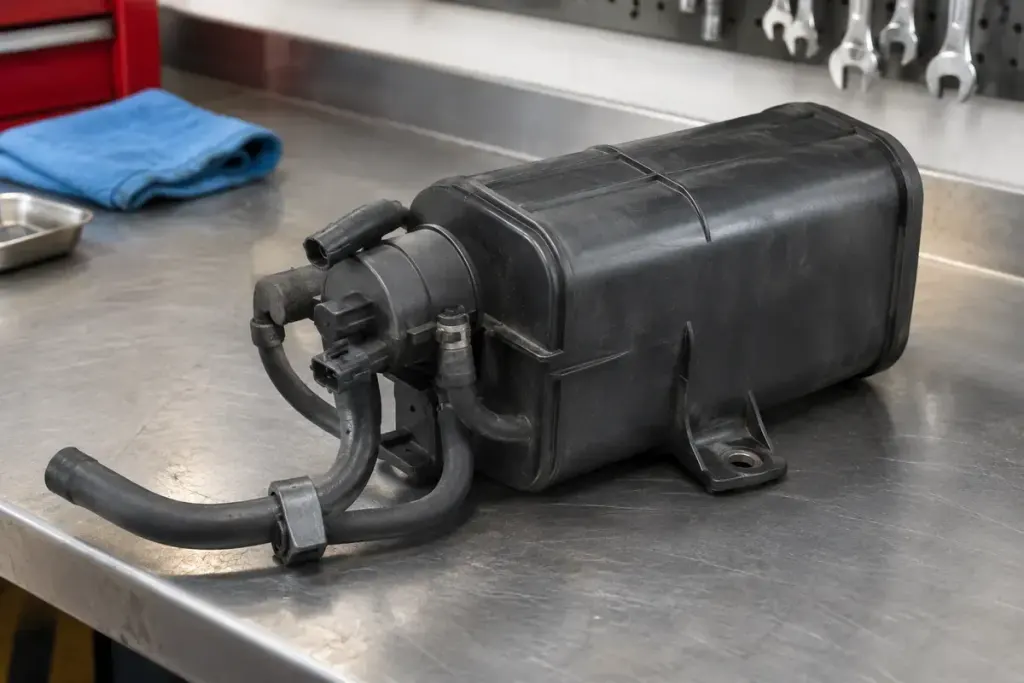
A charcoal canister is not a spare fuel tank and not the filter that cleans liquid petrol on its way to the engine. It belongs to the evaporative-emissions system, where it helps manage fuel vapour that would otherwise escape into the atmosphere.
Toyota’s description of a charcoal canister assembly identifies its role in storing vapour from the tank and routing it for controlled use during engine operation. The exact pipes, valves and control strategy depend on the vehicle.
A temporary store in a controlled system
The canister’s adsorbent material holds fuel vapour. Under the appropriate operating conditions, the system allows that vapour to be drawn toward the engine for combustion. Valves and monitoring are part of the arrangement, which is why a fault described as “EVAP” does not automatically mean the canister itself has failed.
For a simple mental picture, distinguish three jobs: containing vapour, temporarily storing it, and controlling when it leaves storage. A problem anywhere in that chain may require diagnosis. The component name alone does not identify the cause.
Give a technician observations, not a parts order
Record a warning message, any diagnostic code supplied by a workshop, recent repair work and whether the concern appears around refuelling. Do not clear codes repeatedly before assessment or replace parts solely because an online discussion mentions the same warning lamp.
If a fuel smell or visible leak is present, take it seriously and follow the vehicle manual’s safety guidance. Avoid flames and sparks, and obtain appropriate assistance rather than opening hoses to investigate. A canister is not an invitation to perform a home test with fuel vapour.
Use the vehicle-specific refuelling instructions, including when to stop filling. Do not force additional fuel into the tank after the normal shutoff to round up a purchase.
Understanding the canister’s function makes a repair conversation clearer. Ask which test supports the diagnosis and which part of the vapour-control system is involved. That is a more useful route than treating every emissions warning as a reason to buy a new charcoal canister.