
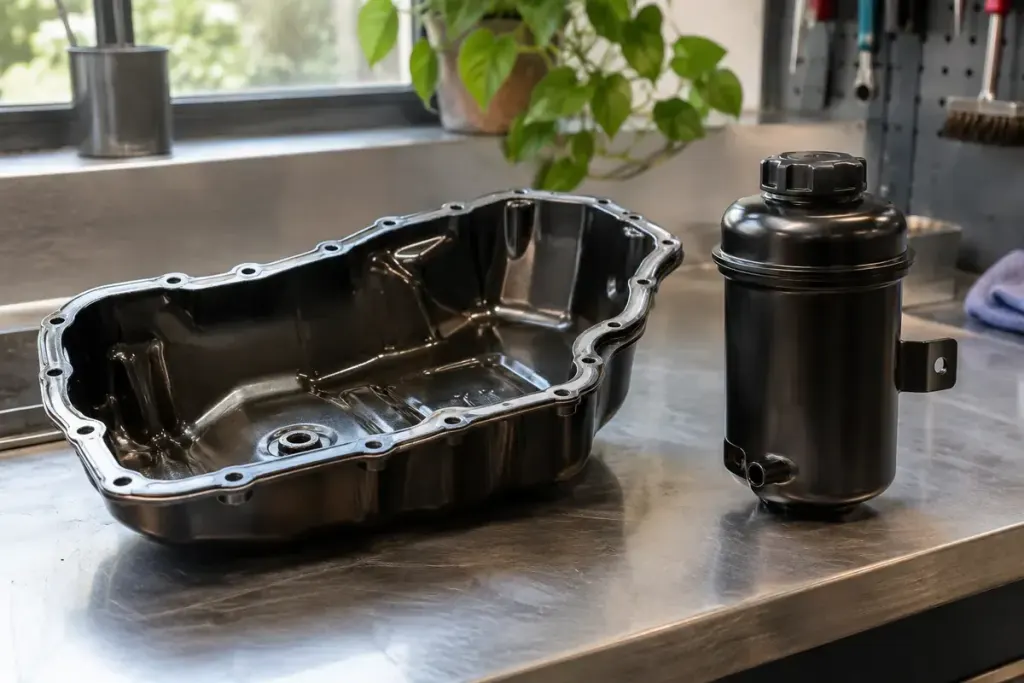
“Dry sump” does not mean an engine runs without oil. It describes a different arrangement for storing and circulating it. The distinction becomes practical when an owner needs to check the level or understand a service explanation.
In a conventional wet-sump arrangement, much of the oil reserve collects in a pan beneath the engine before the pump sends it through the lubrication system. A dry-sump system uses scavenging to return oil from the engine to a separate reservoir, from which it is supplied again. Designs differ, and some manufacturers use integrated arrangements that need their own explanation.
A specific production example appears in Porsche’s 911 S/T technical specification, which lists a separate oil tank and multiple suction stages. That document describes one model; it should not be used as a filling procedure for another car.
Why move the reservoir?
The arrangement can help engineers manage oil supply when the vehicle experiences demanding acceleration and cornering conditions. It also changes packaging, plumbing and the number of components involved. Those benefits and complications belong to the complete design, not to a simple claim that one label always means a better road car.
For an owner, the most important consequence is procedural. Oil may be distributed differently between the engine and reservoir depending on operating conditions. The required temperature, engine state, waiting time and measurement method must come from the vehicle’s manual.
Before adding oil, settle four details
- Confirm the exact engine and lubrication arrangement.
- Find the manufacturer’s level-checking procedure.
- Use the specified oil and the stated measurement conditions.
- Distinguish service-fill quantity from an amount needed for a small top-up.
If a reading seems unexpected, repeat the approved check or ask a qualified workshop. Do not add a guessed quantity because a procedure from a different vehicle produced a low-looking result.
During a service conversation, ask which components were drained and how the final level was verified. A total system capacity is not always the same as the amount removed during routine maintenance.
Following the oil’s route makes the terminology less mysterious. The reservoir’s location explains the name; the model-specific instructions explain what you should actually do with the car.