
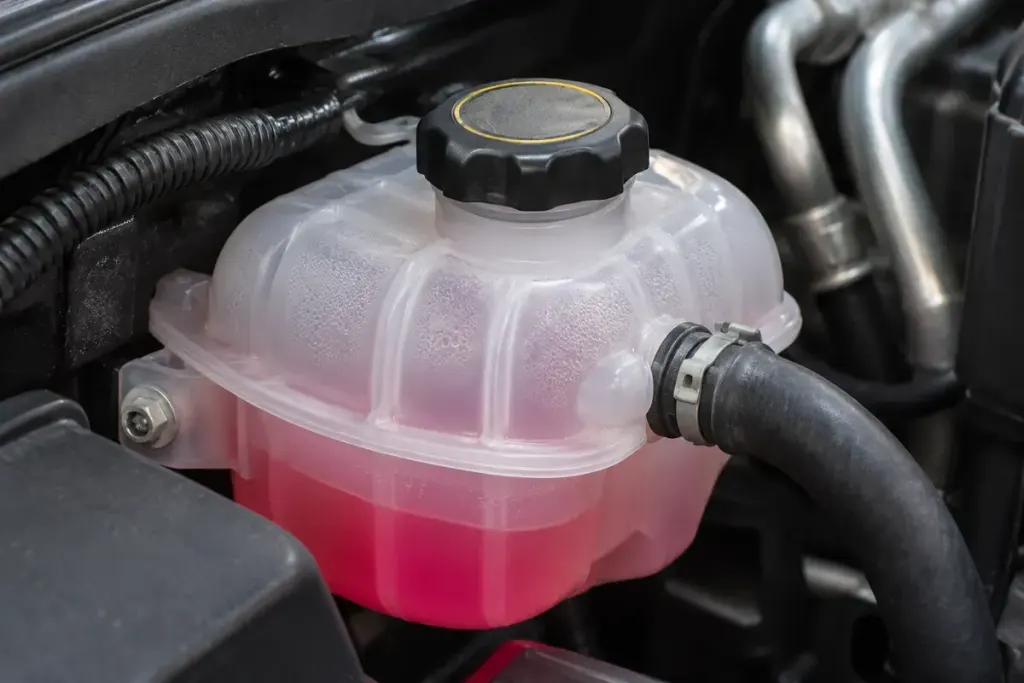
The translucent bottle under the bonnet makes coolant look easy to inspect. But on many cars it is an expansion tank connected to the pressurised cooling system, and its cap does more than keep dirt out.
Behr Hella Service’s cooling-system technical guide describes an expansion tank that receives expanding coolant and a cap valve involved in pressure regulation. Vehicle designs differ: an unpressurised overflow bottle is not automatically the same arrangement. Use the handbook for your model to identify what you are looking at.
Read the level under the specified conditions
Temperature changes the coolant’s volume. Comparing a reading after a long journey with one from a cold morning can therefore be misleading. Follow the manufacturer’s instructions about temperature, vehicle position and the correct marks.
Never remove a pressure cap while the system is hot. Hot coolant and steam can escape and cause serious burns. If the vehicle shows an overheating warning, follow its stopping instructions rather than opening the tank to investigate immediately.
For an ordinary cold check, a dated photograph of the level can be useful. Keep the camera angle similar and note the conditions. The purpose is to describe a pattern accurately, not to decide from a photograph which component has failed.
A replacement cap is a specified part
A cap that physically screws on is not necessarily correct. Its pressure specification and compatibility matter. Ask for the vehicle-specific part rather than treating the cap as a generic lid.
If coolant repeatedly drops, give the workshop the dates, warning messages and any visible residue or puddles. Ask what inspection or pressure test is appropriate. Repeated topping-up does not explain the loss, and coolant colour alone is not a reliable way to choose a compatible product.
Keep the conversation precise: “The cold level moved below the minimum twice this month” is more useful than “the bottle looks empty sometimes.” That observation helps a technician investigate the cooling system while keeping you away from an unsafe hot-cap experiment.