
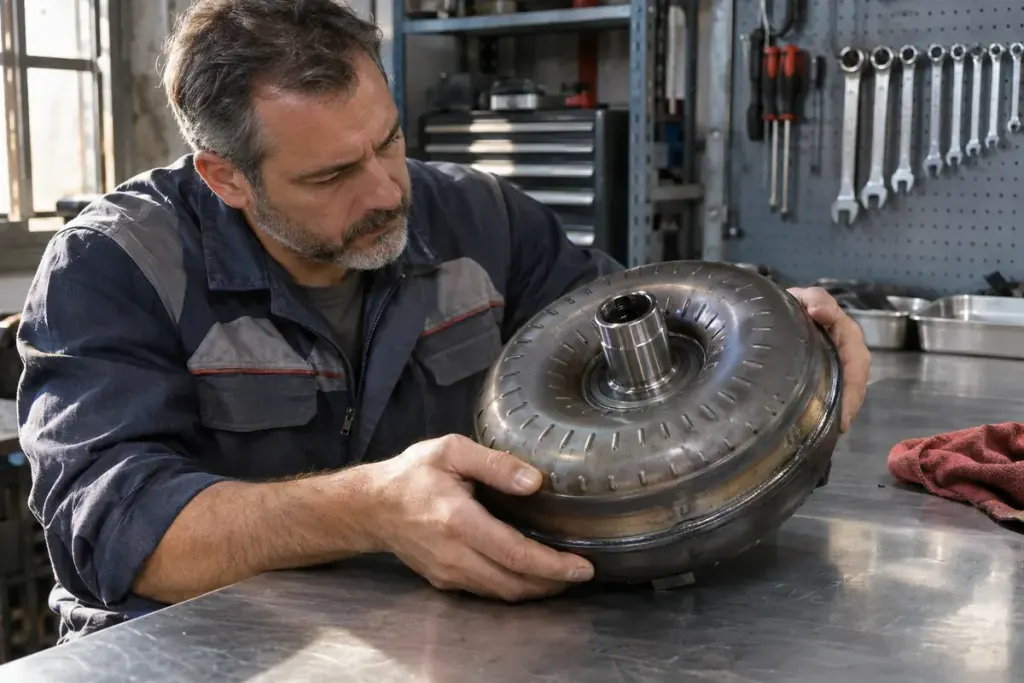
A torque converter advertised with a stall-speed number can sound as though the car should always move off at that engine speed. That is not what the number means. It describes behaviour under particular loading conditions, and the actual result depends on the combination of converter, engine and vehicle.
The parts are not turning together
A torque converter transfers power through fluid between its rotating elements. In the stall condition, the output side is held stationary while the engine drives the input side. This is different from an engine stalling and stopping. It is also different from the lock-up clutch joining the input and output more directly during suitable operation.
TCI’s explanation of converter components describes the roles of the impeller, turbine and stator. A Hays converter-selection guide also makes clear that advertised and actual stall figures can differ with the application. The catalogue number therefore needs its assumptions beside it.
What the number does not tell you
- It is not the transmission’s universal shift point.
- It is not a minimum engine speed below which the vehicle cannot move.
- It is not a target to reproduce repeatedly in ordinary traffic.
- It does not by itself establish that a converter suits a particular engine and use.
Do not perform a brake-held, high-throttle stall test from an internet description. Such testing can generate substantial heat and mechanical load, and any diagnostic procedure belongs with the vehicle manufacturer’s instructions and an appropriately equipped professional.
If you are comparing replacement parts, provide the specialist with the actual vehicle, engine, transmission and intended use. Ask which conditions the advertised figure assumes and what behaviour is expected in normal driving.
For an owner trying to understand a symptom, describe what happened—speed, temperature, load and warning messages—rather than diagnosing it from a stall-speed label. The specification is a tool for a particular engineering question, not a shortcut around the rest of the system.