
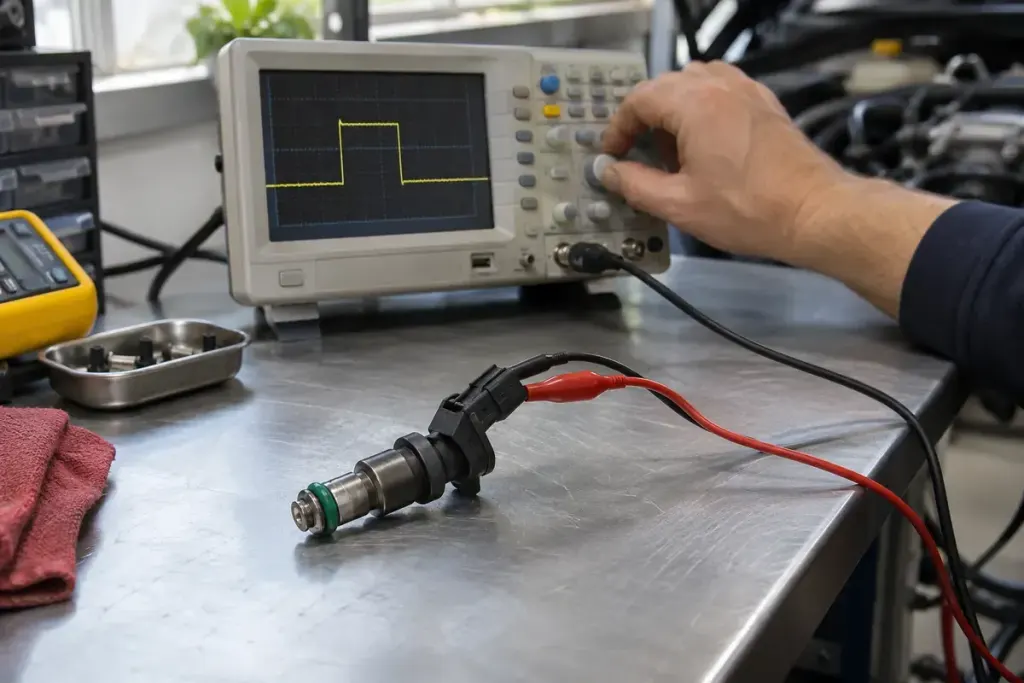
A diagnostic display shows injector pulse width in milliseconds. It is tempting to read a larger number as a direct measure of fuel volume, but the number describes time. How much fuel is delivered during that command also depends on the injector and the conditions around it.
Time is one input to the result
An injector does not necessarily deliver fuel instantly at its full steady-flow rate the moment an electrical command starts. Its opening and closing behaviour matters, particularly at short pulses. The pressure difference across it also affects flow.
Haltech’s injector dead-time documentation explains that the relevant delay can vary with factors such as battery voltage and injector differential pressure. Its short-pulse guidance addresses behaviour in a region where a simple proportional assumption can become inadequate.
Compare like with like
Imagine two engines displaying the same pulse width. If they use different injectors or operate at different fuel pressures, that does not establish equal fuel delivery. Even on one vehicle, a reading taken during cold starting is not directly comparable with one taken after a warm motorway journey.
When discussing a recorded value with a technician, keep the engine speed, temperature, load and any fault codes with it. Note whether the tool reports a commanded electrical duration or a calculated effective value. The label in the service information matters.
A useful question is: “What would the expected value be under these exact conditions, and what other measurement supports the diagnosis?” That encourages a comparison grounded in the manufacturer’s system rather than a universal number found online.
This explanation is not a tuning procedure. Changing injector settings or fuel pressure without the correct data can create serious running problems. For an owner, the benefit is understanding why a workshop checks several related signals before replacing a component. A millisecond figure is a clue within that investigation, not a complete diagnosis by itself.