
In a familiar piston engine, connecting rods and a crankshaft turn reciprocating motion into rotation. A free-piston engine takes a different route: piston movement is not mechanically tied to that conventional crank arrangement.
That difference opens design possibilities, but it also makes control central to the problem. Without a crank fixing the motion in the usual way, the system must manage where the piston travels and how the next cycle begins.
One research example: generate electricity directly
The German Aerospace Center’s research on a free-piston linear generator describes a combustion unit integrated with a linear generator. Instead of first producing shaft rotation for a separate rotating generator, the moving assembly can generate electricity through its linear motion.
DLR’s 2015 explanation of the project discusses it as a possible range-extender concept. That is a dated research description, not evidence that a particular production car currently contains the system.
Separate the engine from the vehicle
For an imaginary range-extender layout, draw three boxes: fuel-to-motion, motion-to-electricity and electricity-to-wheel-drive. A free-piston linear generator changes the first two boxes. The vehicle still needs the other electrical, control and propulsion components appropriate to its design.
This sketch also prevents a common misunderstanding. “Free piston” does not mean free energy, and removing a crankshaft does not remove combustion losses, emissions or maintenance questions. An efficiency claim needs a defined operating point and a clear boundary around the equipment being measured.
When reading a technology announcement, ask whether it reports a simulation, a bench demonstration, a vehicle prototype or a product available to customers. Then look for the fuel, power range, operating conditions and duration of testing.
Two concepts can use the same broad name while differing substantially in layout and control. Following the energy path gives a more reliable understanding than assuming that every free-piston proposal is the same engine with the crankshaft taken away.
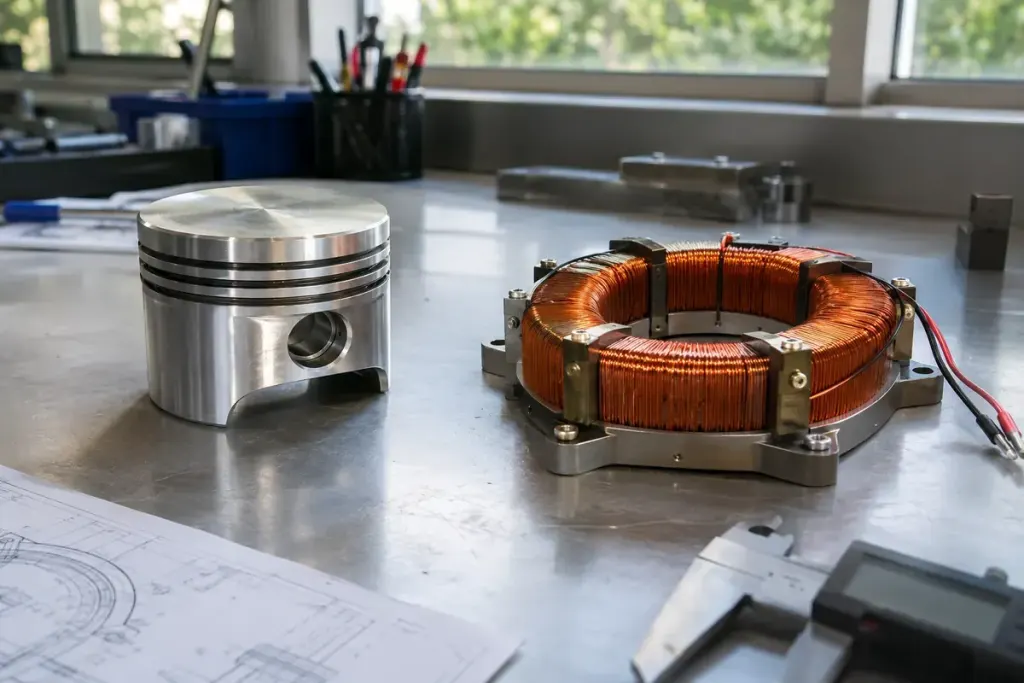
The accompanying AI illustration shows separate components as a conceptual visual; it does not depict an assembled or working free-piston engine.