
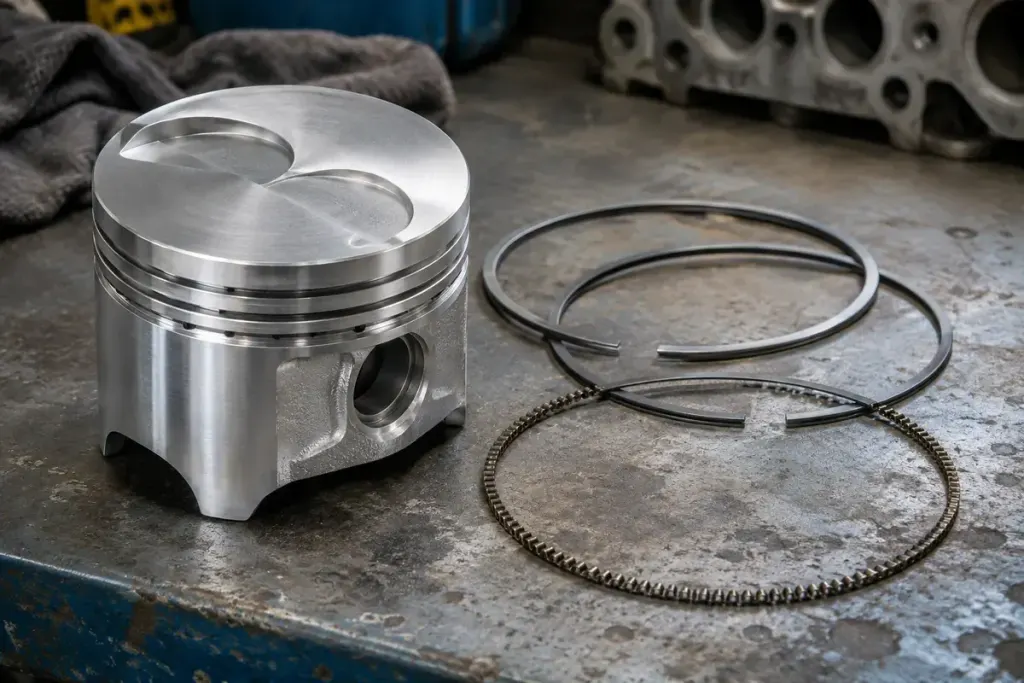
A piston ring set contains parts that look closely related but do different work. The compression rings help contain combustion pressure. The oil-control ring manages oil on the cylinder wall, leaving the lubricating film that the moving parts need while limiting excess oil carried towards the combustion chamber.
“Scraping oil away” can sound as though the aim is a dry cylinder. It is not. The useful distinction is between controlling the film and removing lubrication altogether.
Motorservice’s piston-ring guide explains the oil-control ring’s scraping lands and the pressure-assisted sealing work of compression rings. The components operate together, but one function cannot simply stand in for the other.
In an engine illustration, follow the ring grooves down from the piston crown. Then find the oil return features shown for that particular design. Oil-control arrangements differ: some use multiple pieces and an expander, while others have a different construction. A generic exploded drawing is useful for learning the names, not for choosing replacement parts.
This distinction becomes practical when someone says an engine “has good compression, so the rings must be fine”. A compression result describes one aspect of sealing under the test conditions. It does not, by itself, demonstrate that oil control is working correctly.
Turn a symptom into a better workshop conversation
Record how often oil is added, the distance travelled and the level-checking procedure used. Bring that information with the vehicle’s engine identification. Ask what checks distinguish external leakage, oil entering through other routes and a ring or cylinder problem.
A rise in oil consumption is not a diagnosis of failed oil-control rings. Nor does a blue-looking exhaust photograph identify which part needs replacing. A technician may need several observations and measurements before proposing internal engine work.
For an owner, the most useful takeaway is a precise question: “What evidence points to the oil-control function, and what other causes have been checked?” That keeps a discussion about rings connected to the engine’s actual behaviour rather than to the appearance of one component in a diagram.