
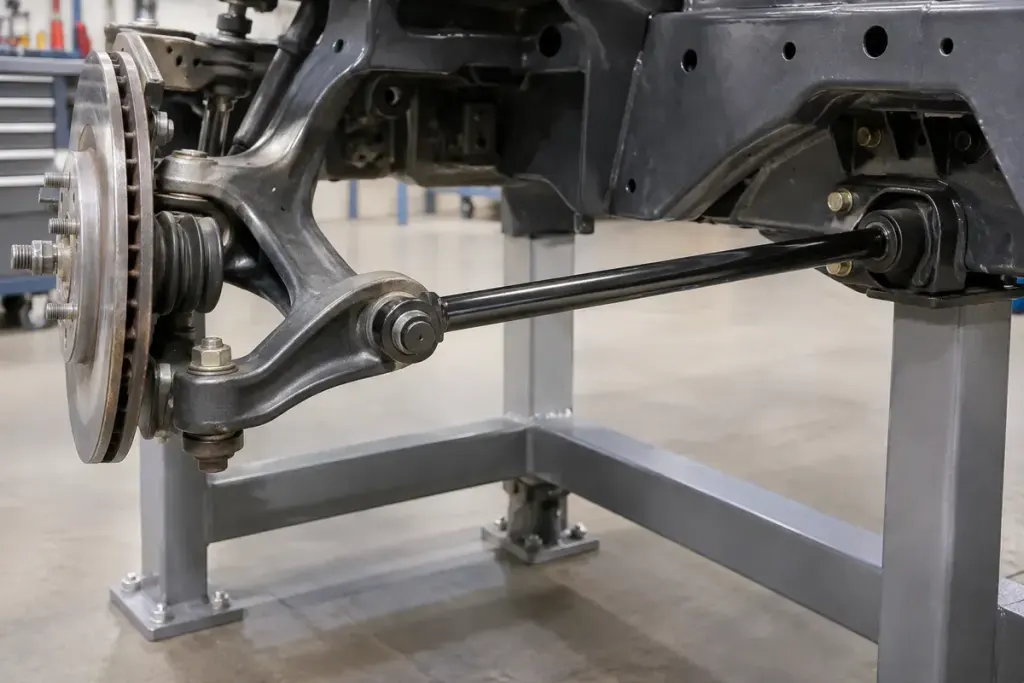
A vehicle can have suspension springs without a visible coil beside each wheel. In a torsion-bar arrangement, a straight spring-steel member provides resistance by twisting as the suspension moves.
The US Navy’s vehicle-suspension training material describes one end attached to an anchor and the other connected to the suspension. Wheel movement turns the connected arm and loads the bar. Within its intended working range, the bar’s elasticity supplies the spring action.
Find the anchor and the moving arm
On a diagram, follow the bar to both ends. Identifying a long rod under the vehicle is not enough: other rods locate components or transmit forces for different purposes. The connection to the arm and the anchored end explain how this particular part acts as a spring.
Now find the damper. Its job is to control motion, while the spring supports load and stores and releases energy as it deflects. The CBSE automotive handbook presents the torsion bar as a spring using torsional elasticity. It is not simply a different name for the shock absorber.
A useful learning exercise is to compare a coil-spring diagram with a torsion-bar diagram and mark the load path in each. Focus on the spring’s connection before comparing the shape of the parts.
Adjustment is not the same as changing the design
Some vehicles provide a model-specific ride-height adjustment associated with the bar’s installation. That does not make an arbitrary turn of an adjuster a safe way to improve handling. Suspension travel, alignment, load and the manufacturer’s procedure still matter.
If a car sits unevenly or its ride changes, describe the symptoms to a competent technician rather than diagnosing the bar from its appearance. Do not work beneath a vehicle supported only by a jack or release a loaded component without the correct procedure.
For ownership notes, record the exact model and suspension specification. “Torsion bar” explains a mechanical principle; the workshop information determines the correct inspection, parts and settings for the car in front of you.