
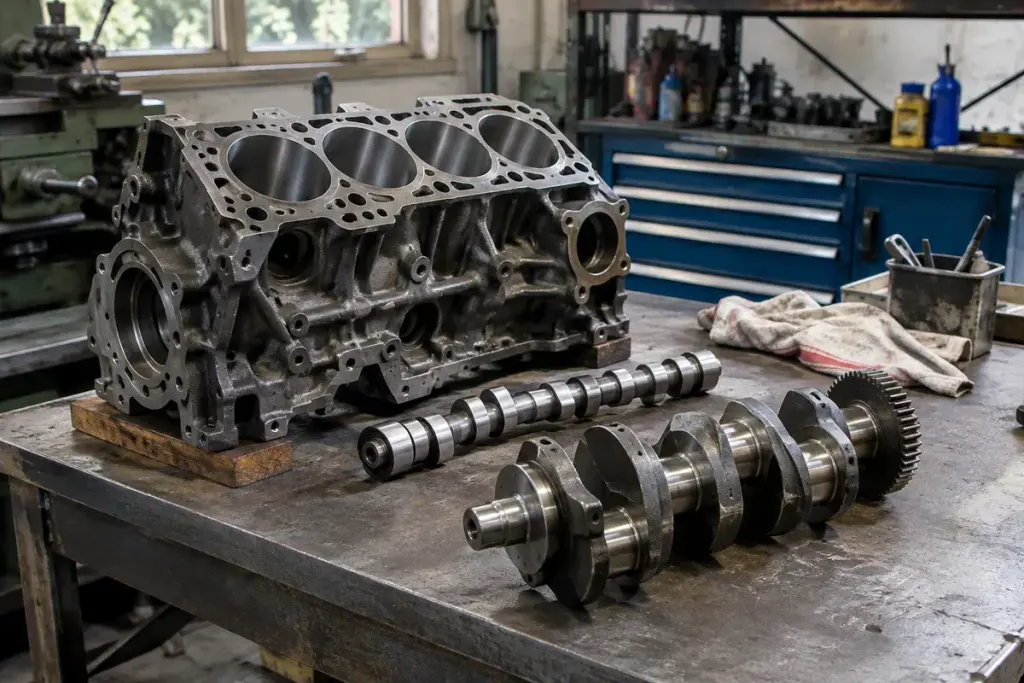
Adding an unbalanced rotating part sounds like an unlikely way to make an engine smoother. A balance shaft does exactly that in a controlled way: its moving mass creates forces timed to oppose particular forces produced by the engine.
The key is the relationship between movements. An engine’s pistons and connecting rods accelerate and decelerate throughout each revolution. Depending on the layout, some of the resulting forces do not cancel naturally. A designed balancing system can reduce a targeted part of that vibration.
Why timing matters as much as the shaft
Honda’s 2001 Accord technical description gives a concrete example: two shafts rotating in opposite directions at twice engine speed to address second-order inertial forces. That is a description of that engine design, not a rule that every engine has the same arrangement.
Toyota’s technical review describes another balance-shaft implementation, including measures to reduce gear noise. These examples show that the balancing function and the way it is packaged and driven are separate engineering choices.
A simple analogy is a carefully timed counter-movement. The useful effect depends on direction, speed and phase. Merely having a rotating weight somewhere in the engine would not produce the same result.
Balance shafts and mounts solve different parts of the problem
A balance shaft acts on forces within the engine system. Mounts support the powertrain and influence how vibration reaches the vehicle structure. A smooth cabin can result from several measures working together, including engine architecture and control.
That also means a new vibration cannot be diagnosed from the term “balance shaft.” The symptom could have other causes. Record when it occurs: cold or warm, stationary or moving, and at which approximate engine speed or operating condition. A technician can use that description alongside inspection and model-specific information.
Follow the actual maintenance documentation
If a repair involves a timing or balance-shaft drive, the manufacturer’s procedure matters. Alignment, tensioning and the particular drive arrangement are not details to infer from another model’s video.
For an owner, the useful takeaway is an engineering distinction. Some vibration is reduced by creating an opposing force, while other measures limit its transmission. Understanding that distinction helps explain the component without turning an unfamiliar vibration into a guessed diagnosis.