
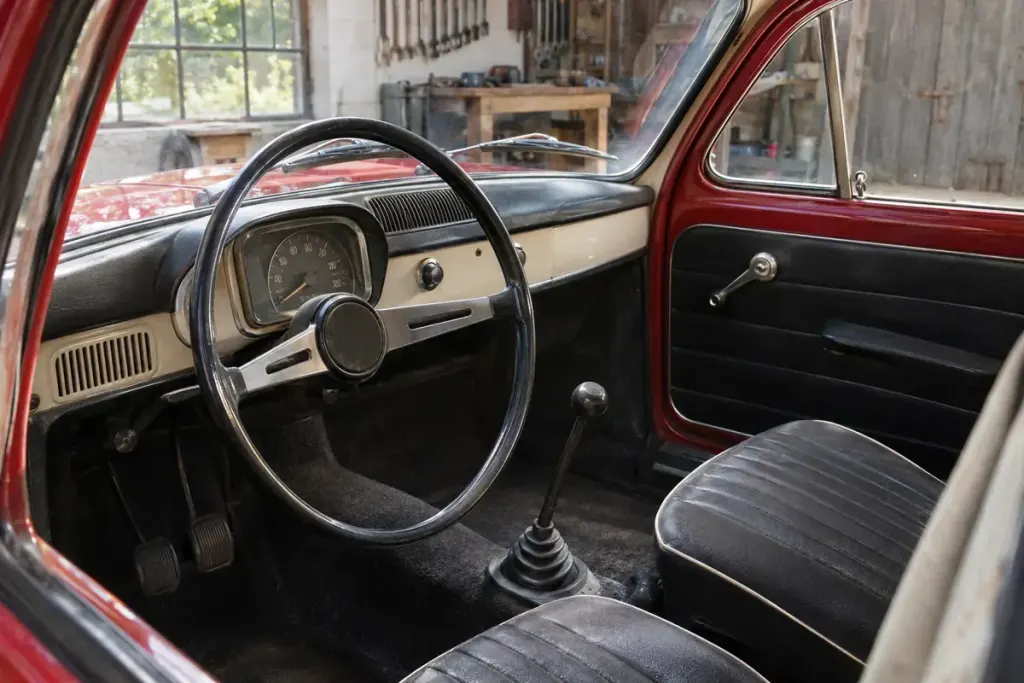
Lift off the accelerator in an ordinary manual car and the engine normally remains connected to the road wheels through the selected gear. Some historic cars offered a freewheel arrangement that changed that relationship. With it operating, the car could coast while the engine returned toward idle.
A preserved 1960 Saab 96 owner’s handbook explains the feature and its control. This is an original manufacturer document hosted by an independent manual archive. It should be read as guidance for the vehicle and configuration it describes, not as a universal instruction for classic cars.
The word “engaged” needs its context
In everyday conversation, “engaged” can sound like a solid connection. In a handbook describing a freewheel, it may mean that the freewheeling function is enabled. Read the complete explanation rather than interpreting the control label from intuition.
The handbook distinguishes ordinary freewheeling from a locked arrangement used when engine braking is required. The practical behaviour therefore depends on the control position and the vehicle’s actual mechanical condition.
Identify the car before operating an unfamiliar control
Check the model year, engine and transmission against the manual. A restored car may contain replacement parts or modifications, and similar-looking controls may not imply the same configuration. Ask a specialist familiar with the vehicle to explain and inspect the system.
For an illustrative handover note, record the control’s location, the exact handbook page and any known modifications. Keep a photograph of the control with the note. Do not reduce the explanation to “pull for normal driving” without the model-specific context.
Never test an unfamiliar freewheel feature on a steep descent or in traffic. A change in engine braking can alter how the car responds when the accelerator is released. Safe operation requires the correct instructions and a mechanically sound vehicle.
Read it as a design choice
The feature is a reminder that familiar pedals and a gear lever do not guarantee familiar behaviour. Historic transmission design addressed the engine, lubrication, comfort and operating expectations of its own period.
Understanding that history starts with the original documentation. Before turning a museum explanation into a driving habit, establish exactly which car, mechanism and operating conditions the explanation belongs to.