
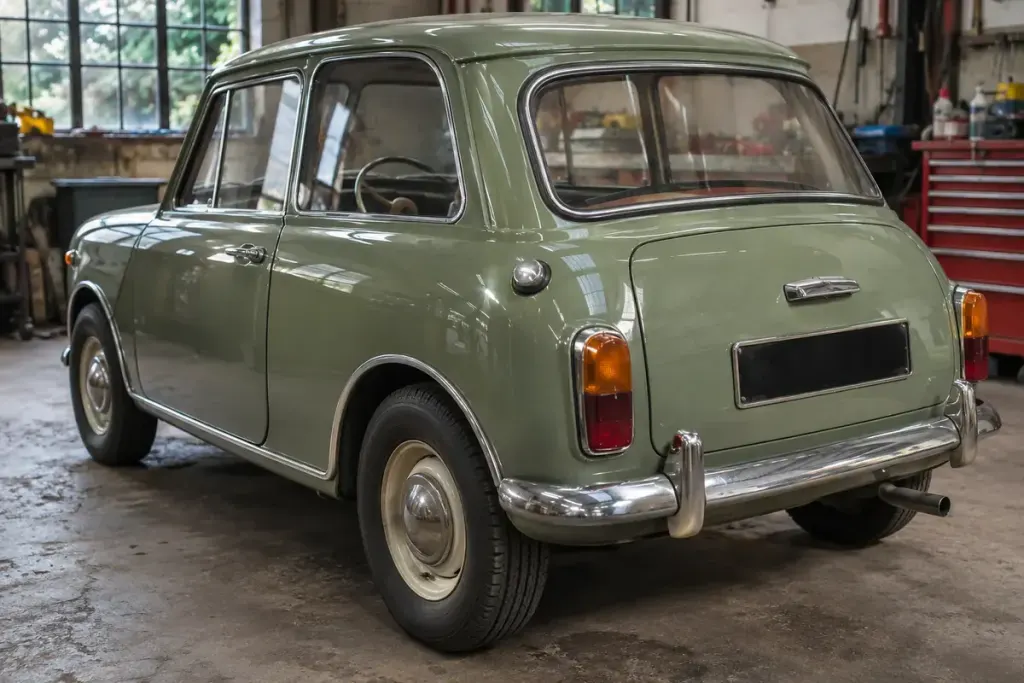
A wheel viewed from behind can lean as it moves with the suspension. In a swing-axle arrangement, the axle’s pivoting movement is closely tied to that changing angle. It is a useful example of why independent suspension describes a broad family of designs, not one uniform mechanism.
Mercedes-Benz’s historical account of the SL distinguishes the low-pivot single-joint swing axle used in particular models from earlier arrangements. The details matter: “swing axle” should not erase differences in pivot location, springs or the rest of the vehicle.
Start with a simple geometric picture
Imagine a straight arm pivoting at its inner end, with a wheel held at its outer end. As the arm swings through an arc, the outer assembly changes position and orientation. That simplified picture helps explain the relationship; it is not a complete diagram of every manufacturer’s suspension.
The wheel’s inward or outward lean is camber. How it changes through movement depends on the actual geometry. Do not take a photograph of a classic car with its wheels hanging on a lift as a complete account of how those wheels sit under the car’s normal load.
Use the design name to ask better questions
When examining a historical vehicle, identify its exact model, year and fitted components before comparing it with a modern car. Ask whether the suspension remains original and whether its condition and setup have been assessed against the correct service information.
A useful inspection record distinguishes design, condition and modification. “This model used a swing axle” is a design statement. “A joint has excessive wear” is a condition finding requiring inspection. “Different springs were fitted” describes a change that needs its own evaluation. Combining all three into a vague claim that the suspension is good or bad loses useful information.
Actual handling and roadworthiness need competent vehicle-specific assessment. The geometric idea is valuable for understanding a museum exhibit or asking informed questions, not for improvising suspension adjustments or testing a classic car’s limits on public roads.