
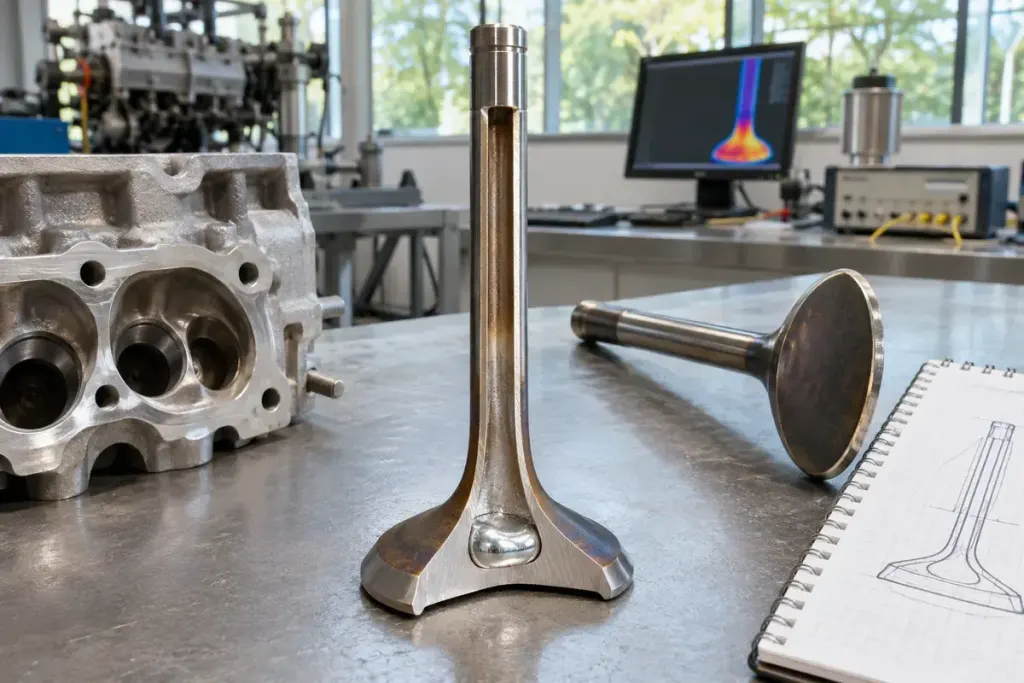
A sodium-filled exhaust valve sounds like an unusual item on an engine specification. The sodium is not an additive poured into the fuel or oil. It is sealed inside a hollow valve, where its behaviour helps transfer heat away from the hot valve head.
Motorservice’s valve explanation describes sodium becoming liquid at operating temperature. As the valve moves, the liquid moves within the cavity and carries heat toward the stem region, where heat can pass through the guide. This motion is often described as a shaker effect.
A heat-transfer route inside a moving part
The exhaust valve operates in a demanding thermal environment. A hollow construction with the specified filling gives the designer another way to manage temperature within the component. It is not the same as a hollow, unfilled valve designed mainly to reduce mass.
Nor does the phrase tell you how much extra power an engine produces. The benefit depends on the complete design and operating conditions. A specification describes a component choice; it does not establish a universal performance improvement that can be transferred to another engine.
What an owner should take from the detail
If an engine repair involves valves, identify the correct part for the actual engine variant. Matching only the visible length and head diameter is not enough to establish equivalence. Ask the workshop how it verified the replacement specification and the related guide and seat work.
A fictional repair note might distinguish “exhaust valve replaced with specified part” from “similar-looking valve fitted”. The first can be checked against the parts and service documentation; the second leaves an important question unanswered.
Do not cut, drill or grind open a discarded valve to see the filling. Motorservice warns that sodium reacts strongly with water and requires appropriate handling. Leave examination and disposal to professionals following the relevant procedure.
The interesting engineering idea is contained inside the sealed part: motion that is necessary for opening the valve also helps move heat. Understanding that relationship is enough to make the specification meaningful without turning it into a workshop experiment.