
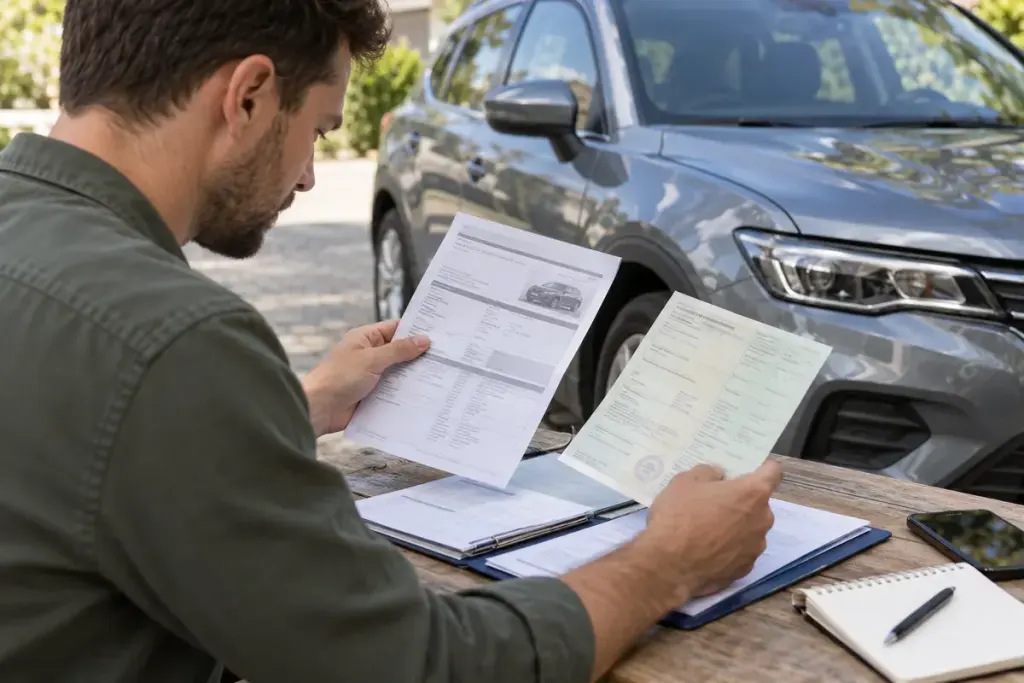
A car can be built in one calendar year, sold as the following model year and first registered later still. An advert that lists only “year” leaves you unsure which of those events it means.
The distinction matters when comparing equipment or finding information for a particular vehicle. A facelift, production change or market-specific version may not line up neatly with the date on a registration document.
Keep three fields separate
- Model year
- The manufacturer’s designation for a model’s production cycle.
- Build date
- When the particular vehicle was manufactured, as supported by its records or identification label.
- First registration
- When it entered the relevant registration system; an imported vehicle may also have an earlier registration history elsewhere.
These are descriptions, not universal rules for every country’s paperwork. In the United States, NHTSA’s manufacturer handbook explains model-year identification in the VIN. That US reference should not be used to assume every vehicle worldwide follows the same decoding conventions.
Match information to the actual vehicle
When an advert is ambiguous, ask the seller which date they quoted and request supporting documentation. Compare the vehicle identifier across the records available to you. A discrepancy needs an explanation; it is not automatically proof of fraud, but it should not be brushed aside.
For parts or servicing, give the supplier the exact vehicle identification and relevant engine or trim information rather than relying on the registration year alone. A part described broadly as fitting “2018 cars” may not cover every production variant or market.
Create a short timeline in your notes and leave unknown fields blank. Do not turn an estimated build period into a precise date. Keeping the distinctions visible helps you ask better questions and prevents a convenient single number from concealing the history you actually need to understand.